
Key Takeaways
- Fat cells make most of the body’s leptin, and its level tells the brain how much energy is stored.
- Fasting starts to lower leptin within 12 hours, and hunger can rise as leptin falls.
- No clinical test exists for leptin resistance, and its definition is still debated.
- Injected leptin works in rare inherited leptin deficiency but not in common obesity.
- GLP-1 medications act on a different appetite signal from leptin.
Leptin is a hormone from fat cells that tells the brain how much energy the body has stored. Leptin resistance is the term for high blood leptin without the expected response from the brain. Only the high level can be measured. Leptin acts most strongly as a signal of shortage, so hunger can rise when leptin falls on a diet.
What Leptin Does
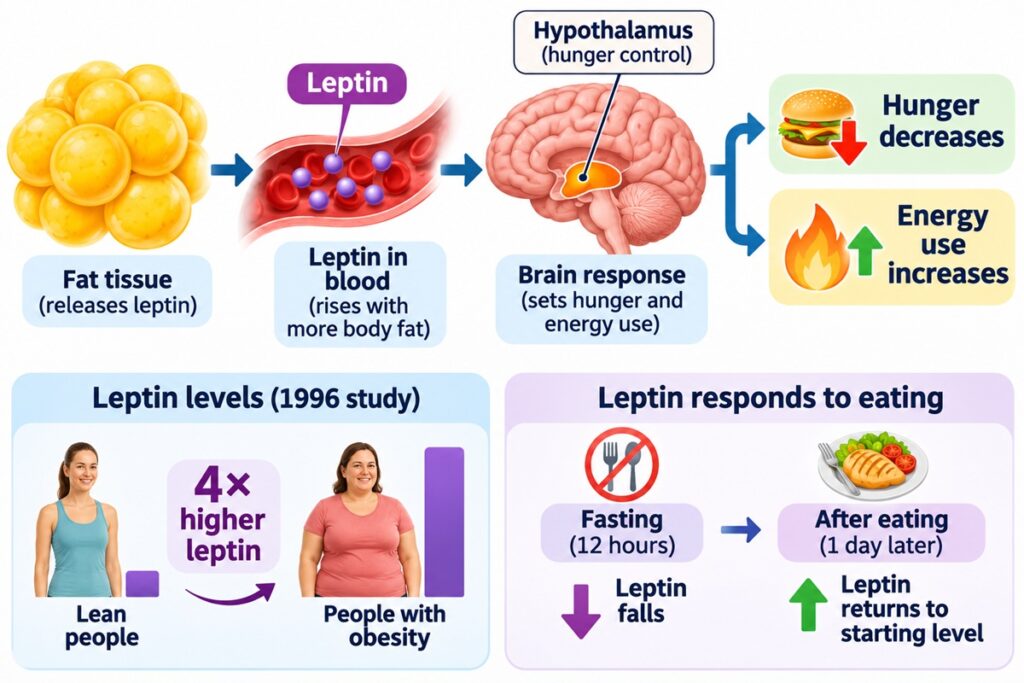
Leptin reports how much fat the body stores. Fat tissue releases leptin into the blood in proportion to body fat. The hypothalamus, the part of the brain that controls hunger, responds to that level to help set hunger and energy use. In a 1996 study of 275 adults, people with obesity had about four times the leptin of lean people.
Leptin also responds to eating before fat mass changes. In one study, leptin began to fall after 12 hours of fasting. It returned to its starting level a day after eating resumed.
Why High Leptin Does Not Switch Hunger Off
High leptin does not switch hunger off because leptin’s main job is to signal shortage, not surplus. When leptin falls, hunger can rise and energy use can drop. Extra leptin given to people at their usual weight has little, if any, effect on body weight. In a 2017 commentary, two leading researchers wrote that the idea of leptin climbing to defend against weight gain “has not been experimentally demonstrated.”
The drop after a diet can last. In a 2011 study that enrolled 50 adults in a 10-week diet, leptin fell and hunger rose, and both changes persisted more than a year later. Those lasting shifts may help explain weight regain after dieting.
What Leptin Resistance Means, and What Is Unproven
Leptin resistance means the brain does not respond to leptin as expected, even though blood leptin is high. The high level shows up in blood tests. The weak response is inferred because people with obesity lose little weight when given extra leptin. A workshop convened by the National Institutes of Health reported in 2012 that the field lacks robust, easily measured markers of leptin’s action. No clinical test or cutoff exists, and no reliable figure shows how many people have leptin resistance.
Cause and effect are also unclear. Obesity itself can make cells resistant to leptin. That makes it hard to tell whether resistance drives weight gain or follows it.
Proposed Causes
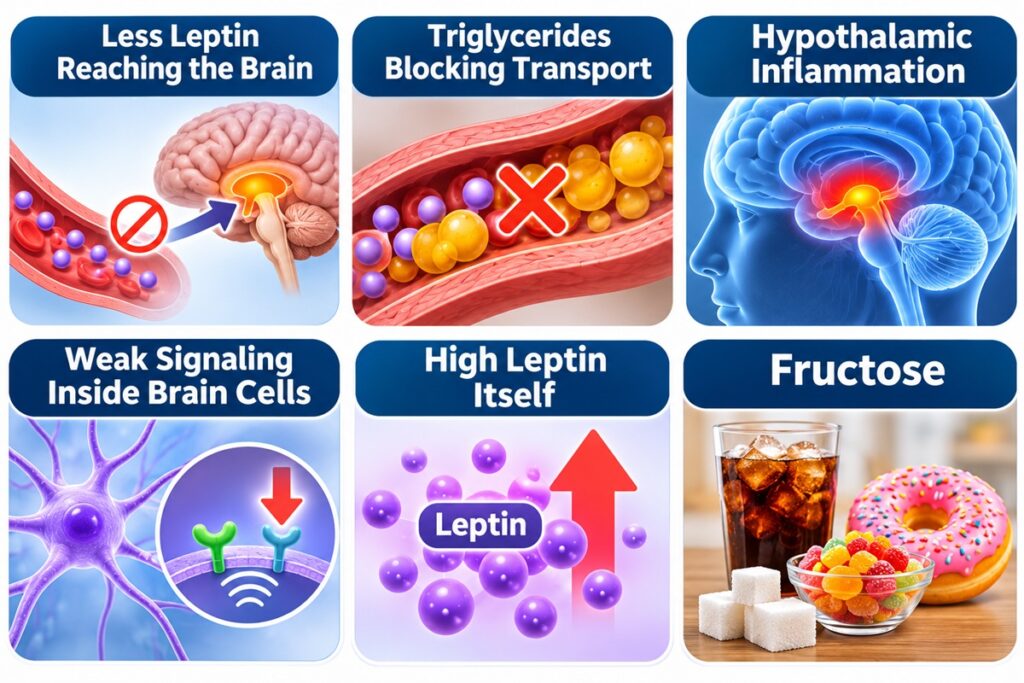
Researchers have proposed several causes of leptin resistance, and most of the evidence comes from animals.
- Less leptin reaching the brain (human, one small study): In 31 people, those with obesity had far higher blood leptin than lean people but only 30% more leptin in the fluid around the brain.
- Triglycerides blocking transport (mice only): Triglycerides, a blood fat, blocked leptin’s passage into the brain.
- Hypothalamic inflammation (animals for cause, humans for association): A high-fat diet inflamed the hypothalamus of rats and mice within days. MRI scans show signs of injury in the same brain area in people with obesity.
- Weak signaling inside brain cells (mice only): Changes inside the cells that sense leptin blunted its signal.
- High leptin itself (mice only): Partly lowering leptin restored the brain’s response to leptin.
- Fructose (rats only): A diet of 60% fructose over six months caused leptin resistance before weight gain. That level is far above human diets.
Why Leptin Shots and Pills Do Not Treat It
Leptin injections help people born without working leptin, but they do not treat common obesity. Congenital leptin deficiency causes severe obesity and constant hunger from the first months of life. Only a few dozen cases have been reported. In three children with the condition, daily leptin injections produced lasting drops in appetite and fat mass. In three adults, average BMI fell from 51.2 to 26.9 over 18 months.
In common obesity, a 24-week trial added daily leptin injections to a reduced-calorie diet. Losses were small and variable, from 1.5 lb to 15.7 lb across very small dose groups. The FDA approves metreleptin (Myalept) only for leptin deficiency caused by generalized lipodystrophy. Its label rules it out for general obesity and reports drug-neutralizing antibodies in patients with obesity who took it.
Pills sold as leptin supplements contain no leptin. Leptin is a protein hormone that cannot be absorbed from a pill.
What Changes Leptin Levels
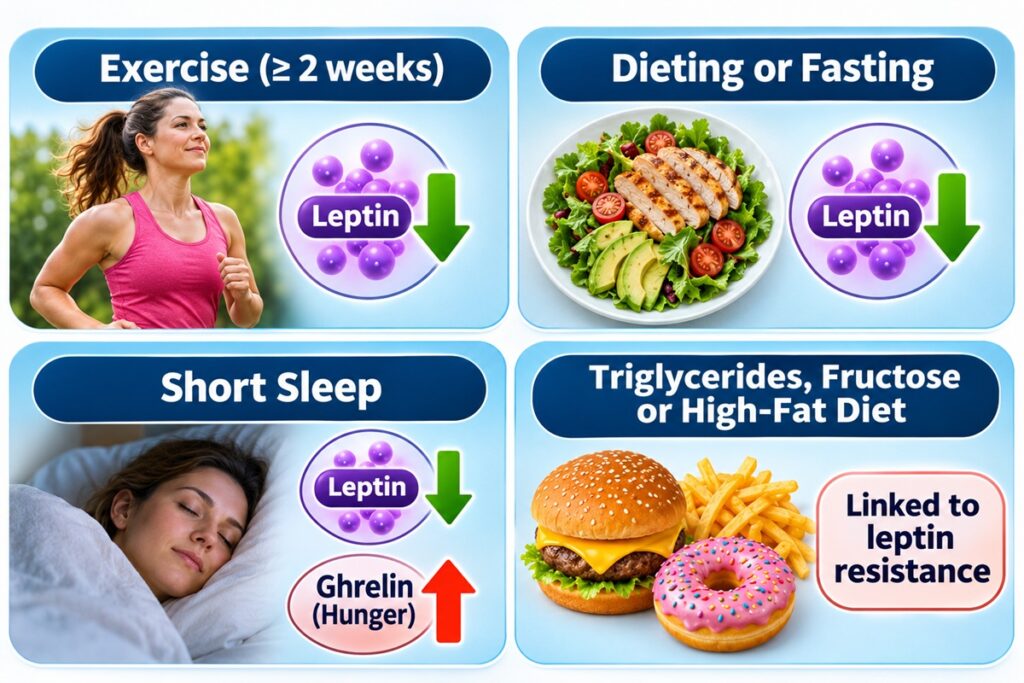
Exercise, dieting, and short sleep change leptin levels in people, but none is shown to change how well the brain responds to leptin.
| Lever | Effect on Leptin | Shown In |
|---|---|---|
| Exercise for two weeks or more | Falls, more when body fat falls (72 trials) | Humans |
| Dieting or fasting | Falls (12 studies) | Humans |
| Short sleep | Lower or unchanged, with ghrelin and hunger higher; two short nights left leptin about a fifth lower than two long nights | Humans, small, short studies |
| Triglycerides, fructose, or a high-fat diet | Linked to leptin resistance | Animals |
No validated human measure of leptin sensitivity exists, so no lever is proven to restore it. A lower leptin level after exercise or dieting does not show that the brain responds better.
Is Leptin the Hunger Hormone?
No, the hormone usually called the hunger hormone is ghrelin. Ghrelin is made mainly in the stomach. Its level nearly doubles just before meals and falls within an hour after eating. In a small trial, a ghrelin infusion raised buffet intake by more than a quarter. Leptin signals store energy, and the study showed a drop in leptin can raise hunger. Leptin works alongside ghrelin and other appetite hormones.
Leptin and GLP-1 Medications
GLP-1 medications act on a different signal from leptin. GLP-1 is a gut hormone released after eating. The FDA labels for semaglutide (Wegovy) and tirzepatide (Zepbound) state that “GLP-1 is a physiological regulator of appetite and caloric intake.” Both labels say the drugs decrease calorie intake, likely by affecting appetite. Semaglutide acts on the GLP-1 receptor, and tirzepatide acts on both the GLP-1 and GIP receptors. Neither drug targets the leptin receptor.
Leptin still falls as weight falls. A later analysis of 392 people in the SURMOUNT-1 trial found leptin 44% to 61% lower than placebo after 72 weeks, depending on the tirzepatide dose. Eli Lilly, the drug’s maker, funded the analysis. In mice, liraglutide, another GLP-1 drug, lowered leptin, and lower leptin made brain cells more sensitive to it. That effect has not been shown in people. No human study of semaglutide and leptin was found. Small, uncontrolled human studies report lower leptin on semaglutide, but no randomized trial has reported it.
Frequently Asked Questions About Leptin
Is There a Test for Leptin Resistance?
No test for leptin resistance exists. A blood test can measure leptin, but no validated marker or cutoff turns that number into a diagnosis.
What Does Ozempic Do to Leptin?
Small, uncontrolled studies report that leptin falls on Ozempic (semaglutide), but no randomized trial has measured it. On tirzepatide, a related drug, leptin falls as weight falls.
Is It Better to Have High or Low Leptin?
Neither high nor low leptin is better on its own. Very low leptin, as in congenital deficiency, causes constant hunger. High leptin in obesity does not stop hunger.
Which Foods Contain Leptin?
No foods contain leptin. Your own fat cells make it, and the approved leptin medicine is given as a daily injection under the skin.
Can You Take Leptin to Lose Weight?
Taking leptin to lose weight is not an approved use. Metreleptin (Myalept) is limited to generalized lipodystrophy and has not been shown to be effective in general obesity.
What Are the Symptoms of Leptin Resistance?
Leptin resistance has no validated set of symptoms. People describe constant hunger, cravings, or trouble losing weight, but these have many causes.
What Hormone Makes You Feel Hungry?
Ghrelin is the hormone best known for making you feel hungry. It was the first hormone in the blood shown to increase how much people eat.
How Do You Treat Leptin Resistance?
No medication is approved to treat leptin resistance, and no diet, exercise plan, or supplement is shown to restore leptin sensitivity in people. Hunger that makes weight hard to manage is worth discussing with a doctor.
Sources
- Myers et al. 2012, Cell Metabolism, NIH workshop report, the lack of robust markers and of a clinical test for leptin resistance.
- US Food and Drug Administration, MYALEPT (metreleptin) label, SPL version 18 (2024), Myalept label on DailyMed, the lipodystrophy indication, the general-obesity contraindication, neutralizing antibodies, and daily injection.
- US Food and Drug Administration, WEGOVY (semaglutide) label, version 19 (2026), Wegovy label on DailyMed, the GLP-1 appetite sentence and lower calorie intake.
- US Food and Drug Administration, ZEPBOUND (tirzepatide) label, version 40 (2026), Zepbound label on DailyMed, GLP-1 and GIP receptor action and lower calorie intake.
- Considine et al. 1996, New England Journal of Medicine, leptin in obese humans, leptin about four times higher in obesity and increasing with body fat.
- Kolaczynski et al. 1996, Diabetes, leptin during fasting, the fall after 12 hours and recovery after eating.
- Rosenbaum and Leibel 2014, Journal of Endocrinology, 20 years of leptin, leptin as a shortage signal and its small effect at usual weight.
- Flier and Maratos-Flier 2017, Cell Metabolism, commentary on leptin’s role, the quoted view that defense against weight gain is not demonstrated.
- Sumithran et al. 2011, New England Journal of Medicine, hormonal changes after weight loss, lower leptin and higher hunger more than a year after a diet.
- Rosenbaum et al. 2005, Journal of Clinical Investigation, low-dose leptin after weight loss, lower energy use after weight loss, restored by leptin.
- Myers et al. 2010, Trends in Endocrinology and Metabolism, leptin resistance, cause or effect, obesity itself producing cellular leptin resistance.
- Caro et al. 1996, The Lancet, leptin in spinal fluid, higher blood leptin but only 30% more brain-fluid leptin in obesity.
- Banks et al. 2004, Diabetes, triglycerides and leptin transport, triglycerides blocking leptin’s entry to the brain in mice.
- Thaler et al. 2012, Journal of Clinical Investigation, hypothalamic injury in obesity, rodent hypothalamic inflammation within days and MRI signs in people with obesity.
- Zhou and Rui 2013, Frontiers of Medicine, leptin signaling review, weakened signaling inside leptin-sensing cells, mostly from mouse studies.
- Zhao et al. 2019, Cell Metabolism, partial leptin reduction in mice, restored leptin sensitivity after lowering leptin in obese mice.
- Shapiro et al. 2008, American Journal of Physiology, fructose and leptin resistance, leptin resistance in rats on a 60% fructose diet.
- MedlinePlus Genetics, National Library of Medicine, congenital leptin deficiency, the rarity and early-onset hunger and obesity.
- Farooqi et al. 2002, Journal of Clinical Investigation, leptin therapy in children, lasting effects in three children with congenital deficiency.
- Licinio et al. 2004, PNAS, leptin therapy in adults, the BMI fall from 51.2 to 26.9 in three adults.
- Heymsfield et al. 1999, JAMA, leptin injection trial, small and variable losses in common obesity on a reduced-calorie diet.
- Fedewa et al. 2018, Sports Medicine, exercise and leptin meta-analysis, lower leptin across 72 trials.
- Varkaneh Kord et al. 2021, Clinical Nutrition, fasting and leptin meta-analysis, lower leptin across 12 studies.
- Spiegel et al. 2004, Annals of Internal Medicine, two nights of short sleep, leptin about a fifth lower with higher ghrelin and hunger.
- Schmid et al. 2008, Journal of Sleep Research, one night without sleep, higher ghrelin with leptin unchanged.
- Cummings et al. 2001, Diabetes, ghrelin around meals, ghrelin nearly doubling before meals and falling within an hour.
- Wren et al. 2001, Journal of Clinical Endocrinology and Metabolism, ghrelin infusion trial, higher buffet intake and the first hormone shown to raise intake.
- Sattar et al. 2026, Journal of the American College of Cardiology, SURMOUNT-1 post hoc analysis, leptin 44% to 61% lower on tirzepatide in 392 participants; funded by Eli Lilly.
- Zhao et al. 2024, Diabetes, leptin reduction in mice, higher leptin sensitivity after the drop on liraglutide, in mice only.