
Key Takeaways
- Walking 30 minutes at 3.5 mph burns 196 calories (820 kJ) at 180 lb.
- Walking a mile at 3.0 to 4.0 mph burns 86 to 94 calories (360 to 393 kJ) at 150 lb.
- Walking 30 minutes at 4.0 mph burns 153 net calories (640 kJ) at 150 lb, out of 187 gross calories (782 kJ).
- Walking with no diet change took off about 3 lb on average in trials of four weeks or more.
For a 150 lb adult, a 30-minute walk at 3.0 mph burns 129 calories (540 kJ). Body weight and pace set the number. Unless marked net, figures are gross and include the calories burned at rest. The figures come from the 2024 Adult Compendium of Physical Activities. Each kJ value in parentheses uses 4.184 kilojoules per calorie.
Calories Burned Walking for 30 Minutes

A 30-minute walk burns 76–429 calories (318 to 1,795 kJ) across the weights and paces below. Each cell gives gross calories, then kJ, for adults 19 to 59 on level, firm ground. A MET is an activity’s energy cost as a multiple of sitting quietly.
| Pace | 120 lb | 150 lb | 180 lb | 210 lb | 240 lb | 270 lb |
|---|---|---|---|---|---|---|
| 2.0 mph (2.8 METs) | 76 (318 kJ) | 95 (397 kJ) | 114 (477 kJ) | 133 (556 kJ) | 152 (636 kJ) | 171 (715 kJ) |
| 2.5 mph (3.0 METs) | 82 (343 kJ) | 102 (427 kJ) | 122 (510 kJ) | 143 (598 kJ) | 163 (682 kJ) | 184 (770 kJ) |
| 3.0 mph (3.8 METs) | 103 (431 kJ) | 129 (540 kJ) | 155 (649 kJ) | 181 (757 kJ) | 207 (866 kJ) | 233 (975 kJ) |
| 3.5 mph (4.8 METs) | 131 (548 kJ) | 163 (682 kJ) | 196 (820 kJ) | 229 (958 kJ) | 261 (1,092 kJ) | 294 (1,230 kJ) |
| 4.0 mph (5.5 METs) | 150 (628 kJ) | 187 (782 kJ) | 225 (941 kJ) | 262 (1,096 kJ) | 299 (1,251 kJ) | 337 (1,410 kJ) |
| 4.5 mph (7.0 METs) | 191 (799 kJ) | 238 (996 kJ) | 286 (1,197 kJ) | 333 (1,393 kJ) | 381 (1,594 kJ) | 429 (1,795 kJ) |
An hour of walking burns about twice the 30-minute figure. A 180 lb adult at 3.5 mph burns 392 calories (1,640 kJ) in an hour.
Calories Burned Walking per Mile
A mile of level walking burns 65–168 calories (272 to 703 kJ) across the weights and paces below.
| Weight | 2.5 mph | 3.0 mph | 3.5 mph | 4.0 mph |
|---|---|---|---|---|
| 120 lb | 65 (272 kJ) | 69 (289 kJ) | 75 (314 kJ) | 75 (314 kJ) |
| 150 lb | 82 (343 kJ) | 86 (360 kJ) | 93 (389 kJ) | 94 (393 kJ) |
| 180 lb | 98 (410 kJ) | 103 (431 kJ) | 112 (469 kJ) | 112 (469 kJ) |
| 210 lb | 114 (477 kJ) | 121 (506 kJ) | 131 (548 kJ) | 131 (548 kJ) |
| 240 lb | 131 (548 kJ) | 138 (577 kJ) | 149 (623 kJ) | 150 (628 kJ) |
| 270 lb | 147 (615 kJ) | 155 (649 kJ) | 168 (703 kJ) | 168 (703 kJ) |
The common rule of 100 calories (418 kJ) per mile fits only near 160 to 175 lb. A 2.0 mph walk burns more per mile than a 2.5 mph or 3.0 mph walk because each mile takes 30 minutes.
How to Work Out Your Own Number
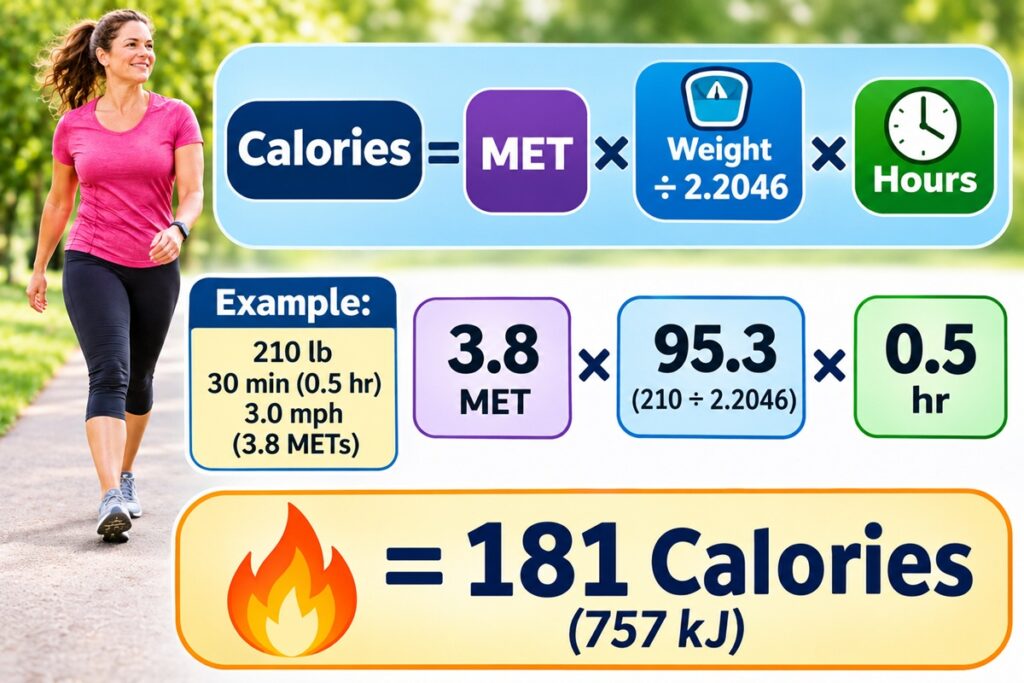
Your own number is the MET value, times your weight in pounds divided by 2.2046, times the hours walked. The MET values already include the resting burn.
For a 210 lb adult walking 30 minutes at 3.0 mph, 210 divided by 2.2046 is 95.3. Multiplying 3.8 METs by 95.3 and by 0.5 hours gives 181 calories (757 kJ).
Why Other Sites Print Different Walking Figures
Other sites print different walking figures because of the MET version, the formula, gross versus net, the walker, and the device.
- The MET version: The 2024 Compendium raised brisk walking at 3.5 mph from 4.3 to 4.8 METs. Tables built on the 2011 values show about 150 calories (628 kJ) for a 30-minute brisk walk at 155 lb. The 2024 values give 169 calories (707 kJ).
- The formula: A common per-minute variant multiplies MET by 3.5 and by body weight, then divides by 200. Its results run 5% higher. A method that scales MET by a predicted basal metabolic rate is a different calculation.
- Gross versus net: Net calories subtract the resting burn. Net is 64% of gross at 2.0 mph and 86% at 4.5 mph.
- The walker: In one study the Compendium authors cite, women with obesity burned 8%–15% more than women without obesity. Adults 60 and older have a separate compendium because their resting rate is lower.
- The device: Watches and fitness trackers estimate differently.
Hills and Stairs
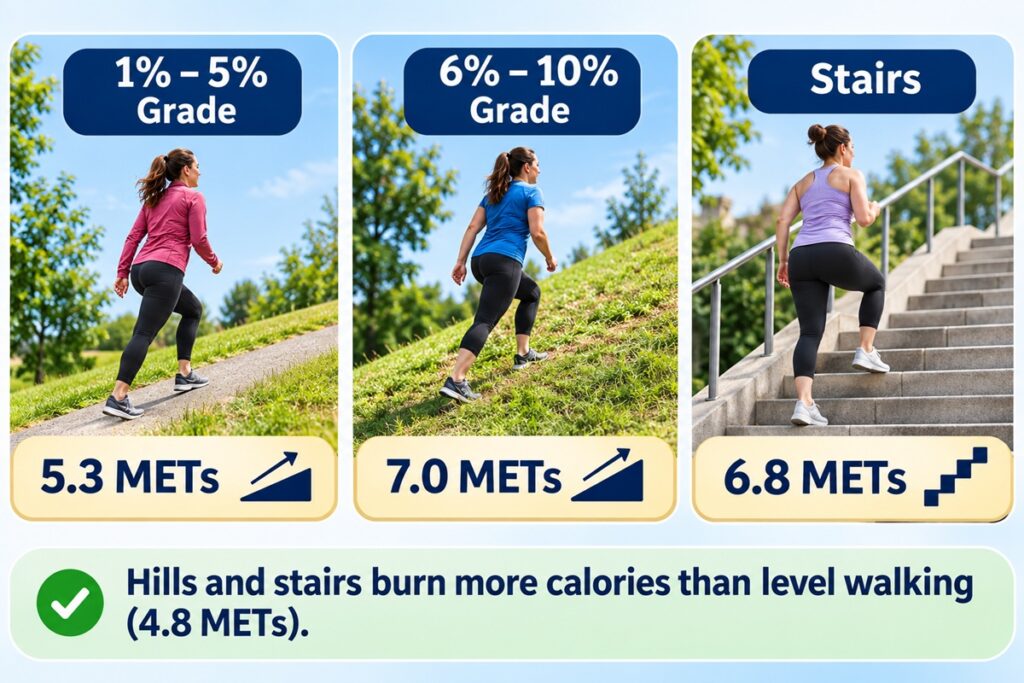
Hills and stairs raise the MET value above the 4.8 METs of level brisk walking.
- Walking up a 1%–5% grade at a moderate to brisk pace is 5.3 METs.
- Walking up a 6%–10% grade at that pace is 7.0 METs.
- Climbing stairs is 6.8 METs.
The American College of Sports Medicine (ACSM) walking equation puts 3.0 mph at a 5% grade at about 1.6 times level walking.
Is Walking Good for Weight Loss?
Walking is good for weight loss in a modest way. It works better when food intake also changes.
- Walking-only trials of four weeks or more produced about 3 lb of loss on average. Pedometer programs that added 20 to 40 minutes of walking a day produced about 2.8 lb over a median of 16 weeks.
- Supervised aerobic exercise such as walking cut about 1.1 lb for each weekly half-hour, and about 6 lb at 150 minutes a week. The trials ran eight weeks or more in adults with overweight or obesity.
- An ACSM position stand says 150 to 250 minutes a week of moderate activity gives only modest loss. The federal Physical Activity Guidelines say losing more than 5% of body weight may take more than 300 minutes a week.
- In a six-month trial in sedentary postmenopausal women, the group that exercised most lost about half the weight predicted from its exercise.
The federal guidelines class brisk walking at 2.5 to 4 mph as a moderate-intensity activity and walking at 4.5 to 5 mph as vigorous.
The rule that 3,500 calories (14,644 kJ) equal one pound predicts a steady rate of loss. A dynamic model from Hall and colleagues shows the rate slows over months. By that model, a sustained calorie deficit of 150 calories (628 kJ) a day leads to about 7.5 lb in the first year and about 15 lb eventually. The 3,500-calorie rule predicts 15.6 lb in one year. The model was built for intake changes, so for walking it’s an estimate.
The federal guidelines also state that regular activity brings major health benefits whether or not weight changes.
Frequently Asked Questions About Calories Burned Walking
How Many Calories Does a 30-Minute Walk Burn?
A 30-minute walk burns 95 to 238 calories (397 to 996 kJ) at 150 lb, from 2.0 to 4.5 mph.
How Many Calories Do 10,000 Steps Burn?
Walking 10,000 steps burns 431 calories (1,803 kJ) gross and 318 calories (1,331 kJ) net at 150 lb and 3.0 mph. That assumes about 5 miles at 2,000 steps per mile. In one study, steps per mile ranged from 1,330 to 1,996, with fewer steps at a faster pace and in taller walkers. Most daily steps are not one continuous walk, so the figure is an upper estimate.
How Much Weight Will You Lose Burning 200 Calories a Day Walking?
Burning 200 calories (837 kJ) a day by walking predicts a loss of 0.4 lb in a week by the 3,500-calorie rule. Hall’s model gives about 10 lb in the first year and about 20 lb eventually if that daily gap continues. Walking trials show smaller losses than this arithmetic.
Can You Lose 2 Pounds a Week by Walking?
Losing 2 pounds a week by walking alone takes a deficit of 1,000 calories (4,184 kJ) a day by the 3,500-calorie rule. At 3.5 mph, that’s 3.9 hours of walking a day at 150 lb and 2.1 hours at 270 lb, counting only the calories above rest.
Is Walking Enough to Lose Belly Fat?
Walking alone shrinks the belly only a little. Walking-only trials in inactive adults cut waist size by about 0.6 inches on average.
Only a walk’s calories above rest add to a deficit in your weekly energy balance. They are 64 to 86% of the table figure.
Sources
- 2024 Adult Compendium of Physical Activities, Walking codes and METs, the MET value for every pace, hill, and stair figure.
- Herrmann et al. 2024, Journal of Sport and Health Science, 2024 Adult Compendium update, the MET definition, the 19 to 59 age range, and the women-with-obesity finding.
- US Department of Health and Human Services, Physical Activity Guidelines, 2nd ed. (2018), the 300-minute figure, intensity bands, and health benefits.
- Jayedi et al. 2024, JAMA Network Open, aerobic exercise dose-response, loss per weekly half-hour and at 150 minutes.
- Murtagh et al. 2015, Preventive Medicine, walking trials meta-analysis, the 3 lb and 0.6-inch averages.
- Richardson et al. 2008, Annals of Family Medicine, pedometer walking meta-analysis, the 16-week result, the added walking time, and 2,000 steps per mile.
- Donnelly et al. 2009, Medicine and Science in Sports and Exercise, ACSM position stand, modest loss at 150 to 250 minutes a week.
- Church et al. 2009, PLoS One, DREW exercise dose trial, the half-predicted loss at the highest dose.
- Hall et al. 2011, The Lancet, energy imbalance and bodyweight, the dynamic model against the 3,500-calorie rule.
- Bernard et al. 2024, Industrial Health, walking equations compared, the ACSM grade equation.
- Welk et al. 2000, Medicine and Science in Sports and Exercise, step counter study, the range of steps per mile.