
A high-protein breakfast gives you about 25–30 g of protein, while the average US adult gets about 15 g, counting people who skipped it. Peanut butter on two slices of whole-wheat toast has 15.1 g of protein and 353 calories.
Two eggs with egg whites and toast have 29.8 g and 288 calories, so you get almost twice the protein for fewer calories.
How Much Protein Makes a Breakfast High Protein
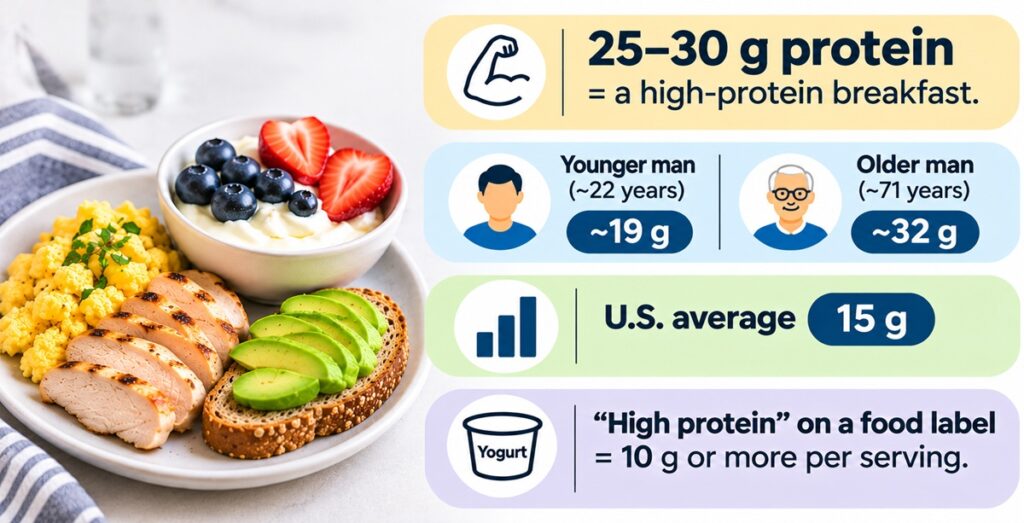
About 25–30 g of protein makes a breakfast high protein. A 2009 review linked that amount at one meal to the most muscle protein synthesis, the process that makes new muscle protein. The review covered younger and older people. That target comes from muscle research rather than weight-loss trials, so it doesn’t tell you how much weight you’d lose.
Body size and age change your number, according to a 2015 analysis that worked out the amount by body weight in men. At 176 lb, the most muscle building comes at about 19 g for a younger man and about 32 g for an older one. The younger men in the analysis were about 22 years old and the older men about 71. Women weren’t in the analysis, so these figures are only a rough guide if you’re a woman.
The 15 g average comes from a US food survey run from August 2021 through August 2023. It covers every adult surveyed, and 17% of them reported no breakfast on the day they were asked about. Those people count as zero, so the average for people who did eat breakfast works out to be higher than 15 g. If you eat breakfast most days, compare your meal with 25–30 g rather than that average.
On a US food label, “high protein” can describe a single food with 10 g or more per reference serving. Protein quality counts, too, because the label’s percent Daily Value for protein is adjusted for how digestible the protein is. The reference serving is a standard amount set for that specific food.
A “high protein” label on a yogurt tells you about that yogurt, and you still need to add up the rest of your breakfast. If a clinician has told you to limit protein, for kidney disease or another reason, follow that advice over any target here.
High-Protein Breakfast Ideas With Calories
Here are 12 breakfasts with their protein and calories, worked out from USDA food entries:
| Breakfast | Protein (g) | Calories (kJ) |
|---|---|---|
| 2 large eggs, 1/2 cup egg whites, 1 slice whole-wheat toast | 29.8 | 288 (1,205) |
| 2 large eggs, 2 oz turkey sausage, 1 slice whole-wheat toast | 30.2 | 337 (1,410) |
| 3 large eggs, 1 oz cheddar | 25.4 | 330 (1,381) |
| 3 oz smoked salmon, 1 large egg, 2 slices whole-wheat toast | 29.8 | 333 (1,393) |
| 1 cup 1% fat cottage cheese, 1/2 cup blueberries | 28.5 | 205 (858) |
| Two 6-oz containers nonfat Greek yogurt, 1/2 cup blueberries | 35.2 | 242 (1,013) |
| 1/2 cup dry oats, 1 cup 2% milk, 1 scoop whey protein isolate | 30.0 | 378 (1,582) |
| 1 scoop whey protein isolate, 1 cup 2% milk, 1/2 cup blueberries | 25.3 | 267 (1,117) |
| 1/2 cup firm tofu, 1/2 cup canned black beans, 1 slice whole-wheat toast | 33.0 | 371 (1,552) |
| 1/2 cup dry oats, 1 cup unsweetened soy milk, 2 tbsp peanut butter | 19.4 | 424 (1,774) |
| 2 slices whole-wheat toast, 2 tbsp peanut butter | 15.1 | 353 (1,477) |
| 1/2 cup dry oats, 1 cup 2% milk | 13.4 | 275 (1,151) |
The final three rows have less than 25 g of protein, and we’ve included them for that reason. Peanut butter toast falls short as a protein breakfast because it only provides 15.1 g of protein. Oats with soy milk and peanut butter have only 19.4 g and 424 calories, the most calories of any row.
These figures leave out cooking fat, so add 40 calories for each teaspoon of oil and 34 for each teaspoon of butter you cook with. The table counts each large egg as 72 calories and 6.3 g of protein, like our guide to egg calories by size and cooking method.
Your whey and tofu may differ from the 28.7 g scoop and the firm tofu prepared with calcium sulfate used here, so read your labels. For single foods instead of meals, see our list of foods sorted by protein per calorie.
Smaller High-Protein Breakfasts on a GLP-1 Medicine
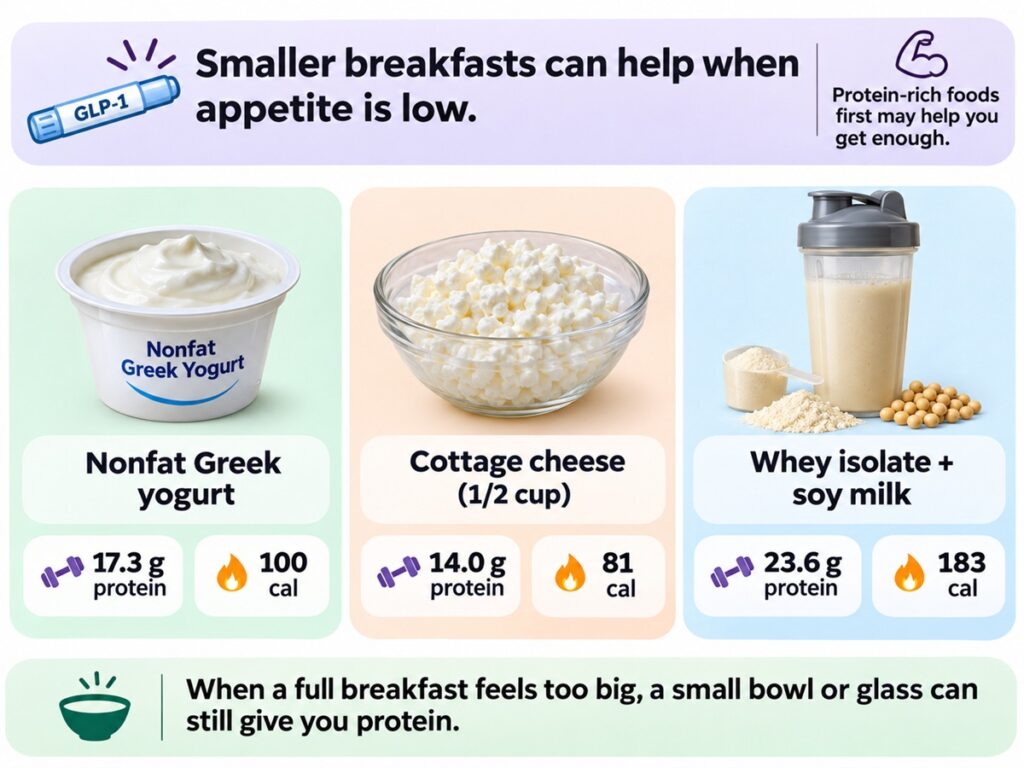
The breakfasts listed in the table above may be too much food for you in the morning if you’re taking Wegovy, Ozempic, Zepbound, or Mounjaro. A small bowl or glass can still give you protein when your appetite is low.
A joint nutrition advisory from 2025 says nausea on these medicines often happens in the morning or after you’ve gone a long time without eating. The advisory also says small meals can work when you aren’t hungry, and that eating protein-rich foods first makes you more likely to get enough.
These three smaller breakfasts suit a morning when you don’t want much food:
- Nonfat Greek yogurt, one 6-oz container: 17.3 g of protein, 100 calories
- Cottage cheese with 1% fat, 1/2 cup: 14.0 g of protein, 81 calories
- Whey protein isolate, one scoop, in 1 cup unsweetened soy milk: 23.6 g of protein, 183 calories
When having a full breakfast, start with protein like eggs or yogurt and leave carbohydrates such as toast or fruit for last. For the rest of your day, see your daily protein target on a GLP-1 medicine.
How to Add Protein to the Breakfast You Already Eat
You can add protein to the breakfast you already eat by adding one food or replacing one. Both changes here use rows from the table.
The first change starts with 1/2 cup of dry oats and 1 cup of 2% milk. One scoop of whey protein isolate gives you about 17 g more protein and 103 more calories. Your bowl goes from 13.4 g to 30.0 g, and its calories go from 275 to 378.
The second change replaces peanut butter on two slices of toast with two eggs, egg whites, and one slice of toast. You get 14.7 g more protein and 65 fewer calories. Your protein goes from 15.1 g to 29.8 g, and your calories go from 353 to 288. Of the two changes, this is the one that lowers your calories.
What a High-Protein Breakfast Does for Fullness and Weight
A high-protein breakfast may make you feel fuller, but the trials we found don’t show that it makes you lose weight. A 2013 trial tested this in 20 young women with overweight or obesity who usually skipped breakfast. Each woman ate a breakfast with 35 g of protein and one with 13 g, both at 350 calories, for six days each.
Fullness was higher on the 35 g breakfast, but daily calories didn’t differ. Don’t assume that feeling fuller means you’ll eat less that day, although the high-protein breakfast did reduce evening high-fat snacking vs skipping.
For 12 weeks, a 2015 trial followed 57 teens with overweight or obesity who usually skipped breakfast. One group ate a breakfast with 35 g of protein, one ate a normal-protein breakfast, and one kept skipping. The 35 g group lost about 0.9 lb of fat while the skipping group gained about 3.5 lb. The high-protein and normal-protein groups didn’t differ, which means this trial doesn’t show that the extra protein would make the difference for you.
A 2019 analysis combined 13 trials in adults that compared eating breakfast with skipping it. In those trials, people who ate breakfast ate about 260 calories a day more than people who skipped it and weighed about 1 lb more. The trials were short and mostly low quality. If breakfast helps you feel less hungry, eat it, but don’t expect it to cause weight loss.
How Many Calories Should You Eat for Breakfast?
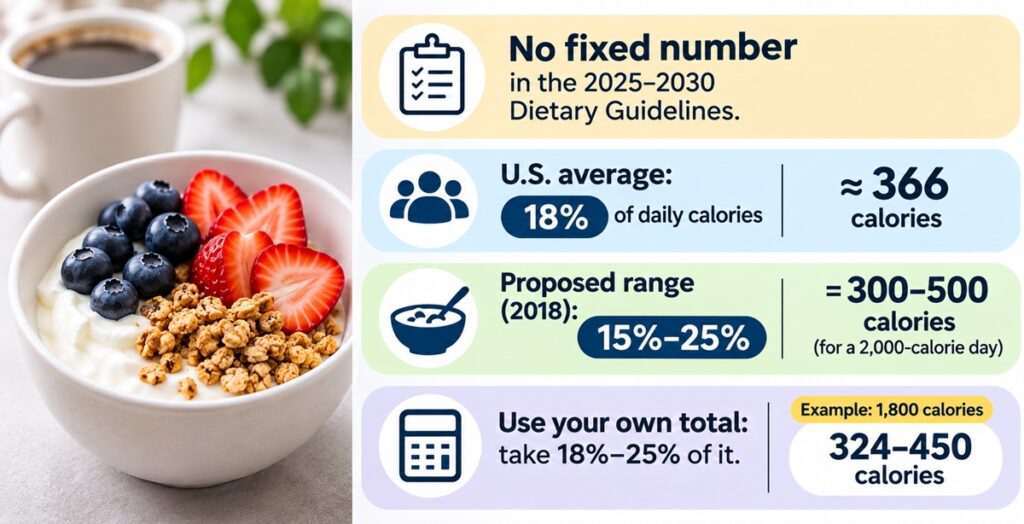
How many calories you should eat for breakfast has no fixed answer in the 2025–2030 US Dietary Guidelines, which give no breakfast figure. In the August 2021–August 2023 food survey, US adults got about 18% of their daily calories at breakfast, or about 366 calories (1,531 kJ). That average counts everyone surveyed, including people who skipped breakfast. It should not be treated as a personal target.
A group funded by cereal companies proposed in 2018 that breakfast be 15%–25% of daily calories, which is 300–500 if you eat 2,000 a day. We’ve found no other formal proposal. UK public health guidance from 2017 gives about 400 calories as a rough guide for breakfast, and it applies in the UK only.
The number of calories you should eat for breakfast depends on your own daily total. Get your daily number from our maintenance calorie calculator, then take a share of it for breakfast.
You can use 18%, the US average share, as your lower limit and 25%, the highest share in the 2018 proposal, as your upper limit. On an 1,800-calorie day, that gives 324–450 calories (1,356–1,883 kJ). All 12 breakfasts in the table have 450 calories or fewer. The yogurt row, at 242 calories, leaves you more calories for lunch and dinner than the egg and sausage row at 337.
Breakfast Size When You’re Losing Weight
In a 2022 crossover trial, 30 adults with overweight or obesity ate a big breakfast for four weeks and a big dinner for four weeks. Daily calories were the same in both periods. Weight loss didn’t differ, so a bigger breakfast may not change what you lose, though participants reported being less hungry.
A 2013 trial followed women with metabolic syndrome eating about 1,400 calories a day for 12 weeks. The group with a 700-calorie breakfast lost more weight than the group with a 700-calorie dinner. The two trials disagree, so you can’t pick a breakfast size from them alone.
Your daily total determines your calorie deficit. Choose a breakfast size that leaves enough calories for lunch and dinner within that total.
Sources
- Protein target: Paddon-Jones and Rasmussen, Curr Opin Clin Nutr Metab Care, 2009; Moore et al., J Gerontol A Biol Sci Med Sci, 2015; USDA ARS What We Eat in America, 2024, data for 2021 to 2023; FDA 21 CFR 101.9, 2023; FDA 21 CFR 101.54, 2016
- Breakfast figures: USDA FoodData Central, 2019
- GLP-1 medicines: Mozaffarian et al., Am J Clin Nutr, 2025
- Fullness and weight: Leidy et al., Am J Clin Nutr, 2013; Leidy et al., Obesity (Silver Spring), 2015; Sievert et al., BMJ, 2019
- Breakfast calories: USDA and HHS Dietary Guidelines for Americans, 2025 to 2030; USDA ARS What We Eat in America, 2024, data for 2021 to 2023; Gibney et al., Nutrients, 2018; PHE Calorie Guidelines Statement, 2017; Ruddick-Collins et al., Cell Metab, 2022; Jakubowicz et al., Obesity (Silver Spring), 2013