
Weight loss stops because each pound lost lowers your daily burn by about 9–14 calories and raises daily appetite by about 45 calories (188 kJ). The appetite change is the larger of the two, so a weight loss plateau is mostly about how much you eat, not a broken metabolism.
At a plateau, you’re eating about what your smaller body now burns, even if your meals seem unchanged.
How to Tell a Plateau From Normal Weight Swings
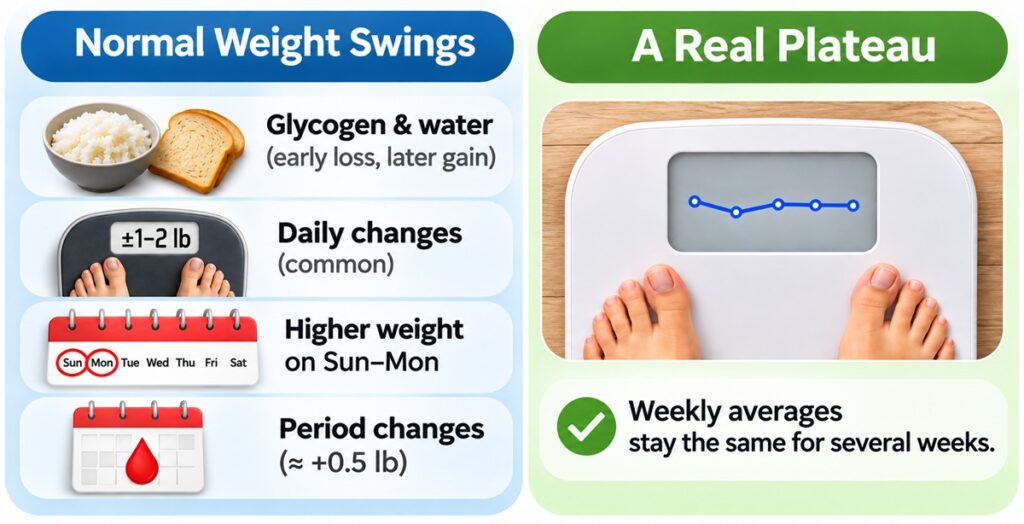
Your fast early loss wasn’t all fat. Glycogen, the carbohydrate your body stores, is bound to water. You lose that water as you use up glycogen, and you gain it back when you eat more carbohydrates.
Day-to-day changes on the scale are often larger than people expect. A 1974 study weighed 140 young men every day. Of their daily changes, 32% measured at least 1.1 lb, and 6.2% measured at least 2.2 lb. A single weigh-in can’t tell you whether you’ve stopped losing.
The day you weigh yourself matters too. A 2014 study of 4,657 daily readings from 80 adults found weights were higher on Sunday and Monday and lower later in the week. If you only weigh in on Monday, after a weekend of restaurant meals, you may see your highest weight of the week.
Some women notice they hold more water around their period. A 1998 study followed 128 women taking a birth control pill. Their average weight rose about 0.5 lb in the first weeks of each cycle and fell by the same amount in the last days. That figure comes from pill users and may not apply to you.
For a general idea of your progress, average your weigh-ins for each week. Call it a plateau only when those averages haven’t dropped for several weeks and your calorie intake and activity haven’t changed.
Why Weight Loss Stops
Three things reduce your deficit as you lose weight, and rising appetite is the largest. The 45-calorie appetite figure and the 9–14-calorie burn figure come from a 2018 review. Its appetite figure is from a 2016 analysis of 153 adults with type 2 diabetes on a drug that removes calories in urine. The review applies that figure more widely.
After a 20-lb loss, those averages work out to about 180–270 fewer calories burned a day. Your appetite would be about 900 calories a day higher than when you started. Those figures describe groups of people, so they can’t forecast your own numbers.
Changes in hunger signals can last long after a diet ends. In a 2011 study, 50 adults started a 10-week, very low-calorie diet. Among the 34 who completed the study, fullness hormones such as leptin fell while hunger rose, and most of those changes were still present at week 62. You may notice this when portions that used to fill you up no longer do.
Sticking to a diet also gets harder over the months. A 2014 modeling study asked why weight loss in trials ends sooner than energy-balance models predict. It found that on-and-off lapses from the diet were a major cause of loss stopping at about six months. If you log less carefully now than in your first month, the food you don’t log can equal your whole deficit.
Your lighter body also needs less energy. A 2011 energy-balance model estimates that an average adult with overweight needs about 10 fewer calories a day for each pound of lasting loss. If you keep eating the same amount, that smaller need alone can reduce your deficit to zero.
The third factor is adaptive thermogenesis, a drop in your calorie burn beyond what your lower weight explains. The effect is real, but it’s small, and some of it goes away. A 2020 study put 71 adults with obesity on 1,000 calories a day for eight weeks, and they lost about 31 lb. At week nine, they burned 92 fewer calories a day at rest than their new weight predicted.
That gap fell to 38 calories a day after four weeks of holding their weight steady, and it was no longer significant at one year. Compared with the rise in appetite, a gap of 92 calories is small. Larger drops have been measured after extreme weight loss, and how your resting and total daily burn fall as you lose weight covers those cases.
Your metabolism probably isn’t the problem. In a 1992 study, 10 adults with obesity said they couldn’t lose weight by dieting. Their total and resting burn were both within 5% of predicted, and the food they left out of their records explained why they weren’t losing.
Weight Loss Plateaus on a GLP-1 Medicine
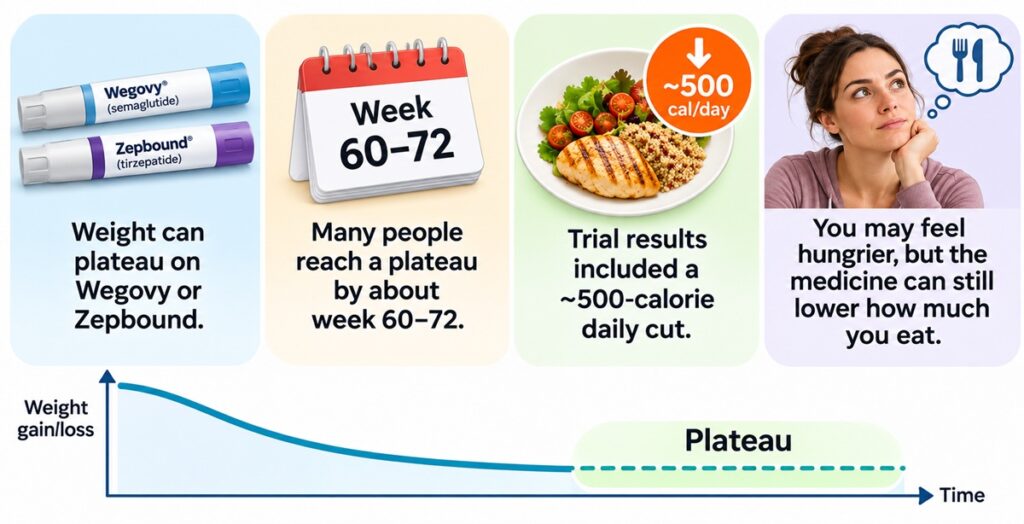
Your weight will probably stop dropping on Wegovy or Zepbound too, and that doesn’t mean the medicine has stopped working. The authors of a two-year semaglutide (Wegovy) trial report that loss in the earlier, shorter trials stopped at about week 60.
For tirzepatide (Zepbound), a 2025 analysis followed people who stayed on the medicine and lost 5% or more. By week 72, 88%–90% of them had reached a plateau. It counted a plateau as less than a 5% change over 12 weeks, so you could still be losing weight slowly.
You may feel hungrier by then, even while the medicine still lowers what you eat. In a 2026 trial, people on semaglutide ate 367 fewer calories at a test lunch at week 20 than when they started. At week 60 they ate 200 fewer, which was still less than the placebo group ate.
Both medicines’ labels also describe trials that put everyone on a diet about 500 calories a day below their needs. So the results you’ve read about came with a calorie cut, and a plateau happened even then. If you take tirzepatide, read what to review on Zepbound or Mounjaro when your weight stops dropping.
When Weight Loss Usually Stops
A 2007 review pooled 80 trials of diets and weight-loss medicines, all with at least a year of follow-up. On average, loss stopped at about six months, at 5%–9% of starting weight. That six-month point is a trial average and doesn’t predict when your own loss will stop.
The 2011 energy-balance model says a steady calorie cut should keep working far longer. By its estimate, an average overweight adult who keeps up a 500-calorie (2,092 kJ) daily cut would eventually lose about 50 lb. About half of that would come off within a year, and almost all of it by the end of year three.
The 2014 modeling study names lapses as a major cause of the difference. It also found a plateau can happen when people follow the diet closely. The 2011 model assumes you keep eating the planned amount, and rising appetite makes that harder over time.
Why Am I Not Losing Weight in a Calorie Deficit?
Most often, you’re not losing weight in a calorie deficit because your real deficit is smaller than your numbers say. That’s true whether your weight never dropped or stopped dropping. Four things can cause that gap, and water shifts can keep the scale from showing fat loss in any single week.
First, people often record less food than they eat. The 10 adults in the 1992 study recorded 47% less food than they really ate. They also overstated their exercise by 51% over 14 days. That 47% applies only to this small group. You can still leave cooking oil, sauces, drinks, and bites out of your own log.
Second, a label can legally understate calories. Under FDA rules, a food is misbranded only if its measured calories are more than 20% higher than the label states. So the calories in a packaged food can legally be up to 20% above the number on the label. That’s a legal limit, not the typical error.
Third, restaurant numbers can be wrong. A small 2010 study lab-tested 29 reduced-calorie restaurant items. On average, they had 18% more calories than stated, and some had twice the stated amount. If you log a restaurant meal from the menu’s calorie count, treat it as a low estimate, and check fast-food calorie facts before you eat out.
Last, a calculator can set your target too high. The NIH Body Weight Planner, a free calculator, notes that its numbers can be too high for very sedentary people and for people with an unusually low metabolism. If you sit most of the day, your maintenance calories may be lower than your first estimate.
What to Change When Your Weight Stops Dropping
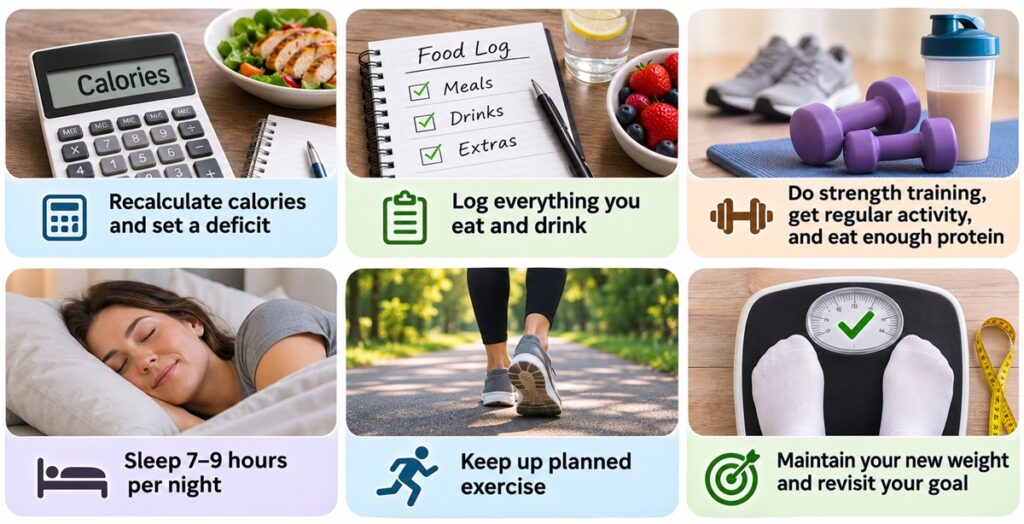
Pick one change that fits what your logs show, and give it several weeks before you judge it by your weekly average. Each of these options addresses one cause of a plateau:
- Recalculate your maintenance calories at your current weight with the maintenance calorie calculator, then subtract the deficit you choose with the calorie deficit calculator. The NIH Body Weight Planner does both steps and can include changes in activity.
- Log everything you eat and drink for one full week, including cooking oils, dressings, alcohol, sodas, juices, and what you add to coffee.
- Do strength training on at least two days a week, plus 150–300 minutes of moderate aerobic activity each week. Eat enough protein to preserve muscle while you lose weight, and see how protein and strength training help you keep muscle for amounts.
- Sleep 7–9 hours a night. In a 2010 trial, 10 adults on a diet spent two weeks with 5.5 hours in bed each night and two weeks with 8.5 hours. On short sleep, they lost 1.3 lb of fat instead of 3.1 lb. Their lean-tissue loss rose from 3.3 lb to 5.3 lb, so total loss was similar.
- Keep up planned exercise. In a 2007 six-month trial in adults with overweight, overall daily activity fell by month three in the groups that only cut calories. It didn’t fall in the group doing structured exercise.
- Keep your new weight if more loss would take more restriction than you want, and revisit your goal and how fast you aim to lose weight.
When to Talk to a Doctor
Some prescribed medicines and health conditions can affect your weight, and their effect can look like an ordinary plateau. An underactive thyroid, called hypothyroidism, affects nearly five in 100 Americans aged 12 and older, and most cases are mild. Its symptoms include tiredness and weight gain, but both are common, so on their own they don’t mean you have thyroid disease.
Talk to your doctor if your weekly average hasn’t changed in several months even after you’ve logged your food and changed your activity and sleep. Ask whether any of your medicines or a condition such as hypothyroidism could be affecting your weight. Keep taking any prescribed medicine unless your doctor tells you to stop, even if you think it’s slowing your loss.
Sources
- Appetite and calorie burn: Hall and Kahan, Med Clin North Am, 2018; Polidori et al., Obesity (Silver Spring), 2016
- Scale swings and water weight: Kreitzman et al., Am J Clin Nutr, 1992; Edholm et al., Ann Hum Biol, 1974; Orsama et al., Obes Facts, 2014; White et al., Obstet Gynecol Int, 2011; Rosenberg, Contraception, 1998
- Why weight loss stops: Sumithran et al., N Engl J Med, 2011; Thomas et al., Am J Clin Nutr, 2014; Hall et al., Lancet, 2011; Martins et al., Am J Clin Nutr, 2020; Lichtman et al., N Engl J Med, 1992
- GLP-1 medicines: Garvey et al., Nat Med (STEP 5), 2022; Horn et al., Clin Obes, 2025; Tronieri et al., Am J Clin Nutr, 2026; Wegovy label, 2026; Zepbound label, 2026
- When weight loss stops: Franz et al., J Am Diet Assoc, 2007; Hall et al., Lancet, 2011; Thomas et al., Am J Clin Nutr, 2014
- Calorie deficit errors: Lichtman et al., N Engl J Med, 1992; FDA 21 CFR 101.9, 2023; Urban et al., J Am Diet Assoc, 2010; NIH Body Weight Planner
- What to change: NIH Body Weight Planner; HHS Physical Activity Guidelines for Americans, 2018; Cava et al., Adv Nutr, 2017; Nedeltcheva et al., Ann Intern Med, 2010; NIDDK Factors Affecting Weight and Health, 2023; Martin et al., Obesity (Silver Spring), 2007
- Seeing a doctor: NIDDK Factors Affecting Weight and Health, 2023; NIDDK Hypothyroidism, 2021