
Key Takeaways
- There is about 61 g of protein in an average chicken breast.
- Raw chicken contains 6.4 g per raw ounce, and roasted 8.8 g.
- 100 g of boneless skinless chicken breast contains 22.5 g raw and 31.0 g roasted.
- The protein in an 8 oz raw breast equals about 51 g after roasting.
The amount of protein in a 100 g chicken breast is 22.5 g raw, but 31 g roasted because roasting removes water, not protein. That doesn’t mean a single chicken breast changes its protein content after roasting, but rather that every figure needs its weight and state for protein amount to be estimated accurately.
| Portion | Protein | Calories (kJ) |
|---|---|---|
| 100 g raw | 22.5 g | 120 (502 kJ) |
| 100 g roasted | 31.0 g | 165 (690 kJ) |
| 1 oz raw | 6.4 g | 34 (142 kJ) |
| 1 oz roasted | 8.8 g | 47 (197 kJ) |
| 4 oz raw, label reference | 25.7 g | 137 (573 kJ) |
| 3 oz roasted, label reference | 26.4 g | 140 (586 kJ) |
| 4 oz roasted | 35.0 g | 186 (778 kJ) |
| Average raw breast, 9.6 oz (272 g) | 61.2 g | 326 (1,364 kJ) |
| Average grilled breast, 6.9 oz (196 g) | 59.8 g | 296 (1,238 kJ) |
Chicken breast protein figures come from USDA records 171077, 171477, and 171534, skinless meat only.
Protein in One Chicken Breast
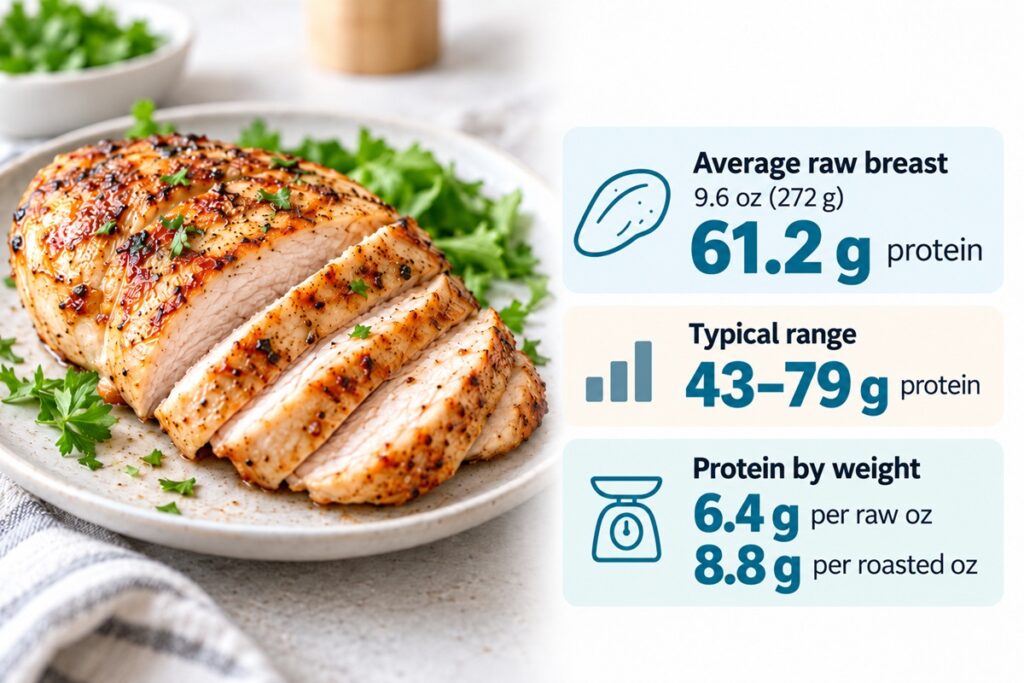
One raw boneless skinless breast of USDA’s average weight, 9.6 oz (272 g), holds 61.2 g of protein. That average comes from 13 retail samples. One standard deviation either side spans 6.7–12.5 oz, or about 43–79 g of protein. The grilled average comes from 74 pieces.
A breast of any weight holds 6.4 g of protein per raw ounce or 8.8 g per roasted ounce.
Why Cooked Chicken Breast Shows More Protein
Cooked breasts show more protein per 100 g because they hold less water. An 8 oz raw breast holds about 51 g of protein. Roasted at USDA’s 72% mean yield, it weighs about 5.8 oz and still holds about 51 g. That yield comes from 1975 broiler-fryer data, so it is only an estimate for boneless skinless breasts.
Logging a raw weight against a cooked per-100 g figure overstates protein by about 38%, and the reverse understates it by about 27%.
Five common online figures each describe a different state or portion:
- 22.5 g per 100 g raw, or 6.4 g per ounce
- 25.9 g per 3 oz (85 g) grilled, or 8.6 g per ounce
- 31.0 g per 100 g roasted, or 8.8 g per ounce
- 32.1 g per 100 g braised, or 9.1 g per ounce
- 33.4 g per 100 g pan-fried without coating, or 9.5 g per ounce
Every method removes water, and none adds protein. The page on calories by cooking method gives each method’s calories.
Under 9 CFR 381.412, the label reference amounts for poultry cuts are 4 oz (114 g) ready-to-cook and 3 oz (85 g) ready-to-serve.
How Much Protein Is in Other Chicken Cuts
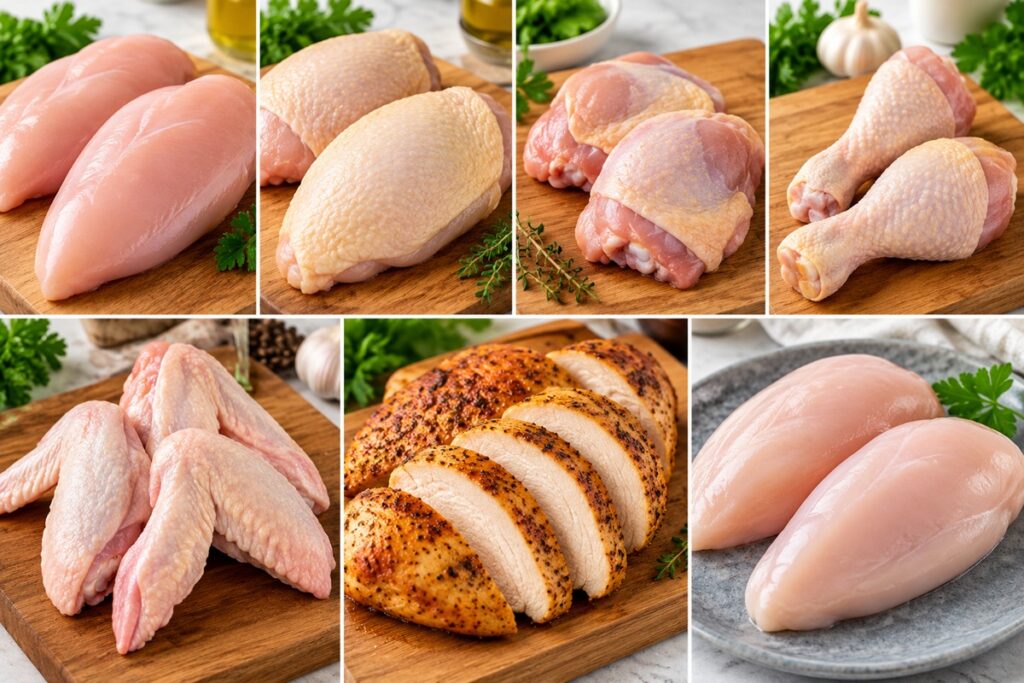
Breast and wing meat lead on protein per 100 g, and thigh and drumstick carry less. Cooked means roasted, and every row but breast with skin is meat only.
| Cut, per 100 g | Protein, Raw | Protein, Cooked | Calories, Cooked (kJ) |
|---|---|---|---|
| Breast | 22.5 g | 31.0 g | 165 (690 kJ) |
| Breast with skin | 20.8 g | 29.8 g | 197 (824 kJ) |
| Thigh | 19.7 g | 24.8 g | 179 (749 kJ) |
| Drumstick | 19.4 g | 24.2 g | 155 (649 kJ) |
| Wing | 22.0 g | 30.5 g | 203 (849 kJ) |
| Rotisserie breast | Not listed | 28.0 g | 137 (573 kJ) |
| Breast with added solution | 20.3 g | Not listed | Not listed |
Skin raises roasted breast fat from 3.6 g to 7.8 g per 100 g and lowers the protein per gram. Raw breast with added solution has about one-tenth less protein than plain raw breast.
How Much of a Day’s Protein a Breast Covers
A 3 oz roasted serving covers about half of an adult’s daily reference intake, and one average grilled breast exceeds it. The Recommended Dietary Allowance is 0.36 g of protein per pound of body weight a day, and its adult references are 46 g for women and 56 g for men.
A 2025 advisory from four US obesity and nutrition societies cites a proposed 0.54 to 0.73 g per pound a day during active weight loss. FDA prescribing information describes GLP-1 as a regulator of appetite and calorie intake, so a medication acting on it may cut the calories a person eats. The page on protein needs on GLP-1 covers targets on those medications.
Frequently Asked Questions About Chicken Breast Protein
How Much Chicken Breast Gives 30 g of Protein?
Chicken breast gives 30 g of protein in 3.4 oz roasted or 4.7 oz raw.
How Much Chicken Breast Is 100 g of Protein?
Chicken breast holds 100 g of protein in 11.4 oz roasted or 15.7 oz raw.
How Much Protein Is in 4 oz of Cooked Chicken Breast?
A 4 oz serving of roasted chicken breast holds 35 g of protein.
Are Two Chicken Breasts a Day Enough Protein?
Two USDA-average grilled breasts a day supply 119.6 g of protein, over twice that of either adult reference. Both references use 0.36 g per pound of body weight a day.
More Calorie Counts
- Calories in Chicken Breast
- Calories in an Egg
- Rice Calories
- Baked Potato Calories
- Banana Calories
- Calories in a Slice of Pizza
- Big Mac Calories
- Calories in Food: the full guide
Sources
- USDA FoodData Central, SR Legacy record 171077, raw boneless skinless breast, published April 2019, supports the raw protein, calorie, and per-ounce figures.
- USDA FoodData Central, SR Legacy record 171477, roasted breast, meat only, published April 2019, supports the roasted protein, calorie, fat, and per-ounce figures.
- USDA FoodData Central, SR Legacy record 171534, grilled boneless skinless breast, published April 2019, supports the grilled 3 oz, per-ounce, and whole-breast figures.
- USDA FoodData Central, SR Legacy record 171140, braised boneless skinless breast, published April 2019, supports the braised figures.
- USDA FoodData Central, SR Legacy record 171078, fried breast, meat only, published April 2019, supports the pan-fried figures.
- USDA FoodData Central, SR Legacy records 171474, raw breast with skin, and 171075, roasted breast with skin, published April 2019, support the breast with skin row and its fat figure.
- USDA FoodData Central, SR Legacy records 173627, raw thigh meat, and 172388, roasted thigh meat, published April 2019, support the thigh row.
- USDA FoodData Central, SR Legacy records 173614, raw drumstick meat, and 172376, roasted drumstick meat, published April 2019, support the drumstick row.
- USDA FoodData Central, SR Legacy records 173632, raw wing meat, and 172392, roasted wing meat, published April 2019, support the wing row.
- USDA FoodData Central, SR Legacy record 171518, rotisserie breast, meat only, published April 2019, supports the rotisserie row.
- USDA FoodData Central, SR Legacy record 171509, breast with added solution, published April 2019, supports the added-solution row.
- USDA Agricultural Research Service, SR28 full release, NDB 05062 and 05747 portion weights, supports the raw piece average of 272 g (13 samples, standard deviation 81 g) and the grilled piece average of 196 g (74 samples).
- USDA Agricultural Research Service, USDA Table of Cooking Yields, December 2012, supports the 72% mean yield for roasted broiler-fryer breast, measured in 1975.
- eCFR, FSIS poultry reference amounts, 9 CFR 381.412, current as of October 2026, supports the 114 g ready-to-cook and 85 g ready-to-serve reference amounts.
- Institute of Medicine, Dietary Reference Intakes Summary Tables, NAP 13050, chapter 24, 2011, supports the protein RDA and the 46 g and 56 g adult reference intakes.
- Mozaffarian et al., Am J Clin Nutr 2025, joint advisory on nutrition during GLP-1 therapy, supports the higher protein range proposed during active weight loss.
- FDA prescribing information, Wegovy sections 12.1 and 12.2, DailyMed Wegovy label, SPL version 19 effective June 18, 2026, supports the statements that GLP-1 regulates appetite and calorie intake and that the medication decreases calorie intake.
- FDA prescribing information, Zepbound section 12.1, DailyMed Zepbound label, SPL version 40 effective August 28, 2026, supports the statement that GLP-1 regulates appetite and calorie intake.