
Cooked long-grain white rice has 205 calories in one cup (158 g) and 130 calories in 100 g. The same rice has 365 calories in 100 g when dry and uncooked. Rice calories differ this much because cooked rice is mostly water, so check whether a figure is for cooked or dry rice before you use it.
Calories in White, Brown, Jasmine, Basmati, and Wild Rice
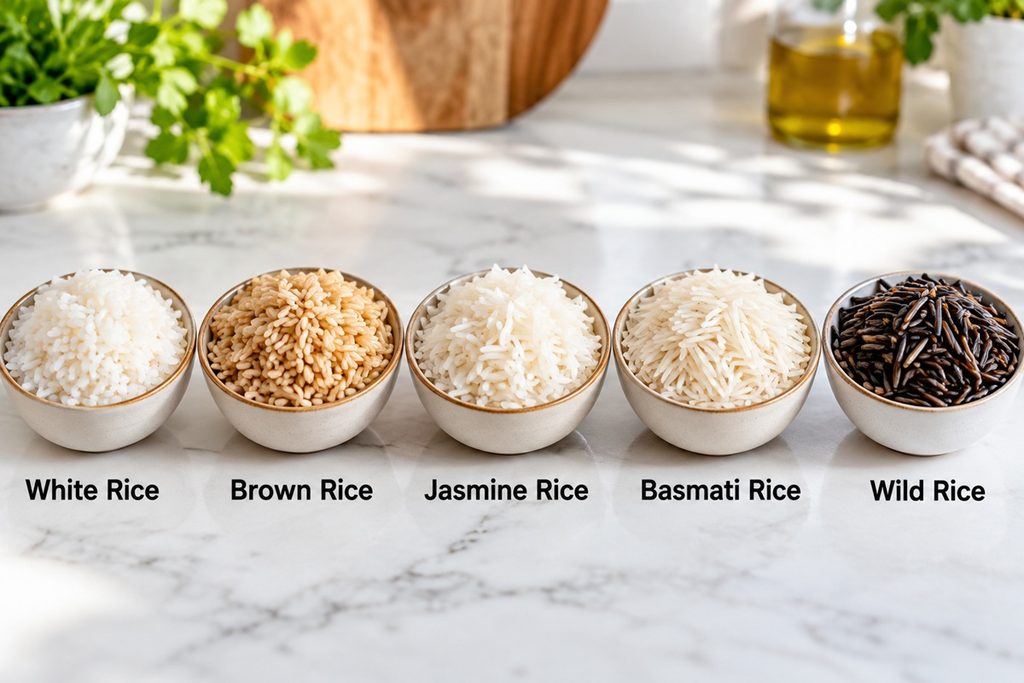
Each rice type is listed with its calories and kilojoules per cooked cup, the two units used in our calorie and kilojoule counts for other foods. Dry jasmine and basmati figures come from package labels, and the rest come from the USDA:
| Rice | Weight of 1 cooked cup | Calories per cooked cup | Kilojoules per cooked cup | Calories per 100 g cooked | Calories per 100 g dry |
|---|---|---|---|---|---|
| White, long-grain | 158 g | 205 | 859 | 130 | 365 |
| White, medium- or short-grain | 186 g | 242 | 1,012 | 130 | 358–360 |
| Brown, long-grain | 202 g | 248 | 1,040 | 123 | 367 |
| Wild | 164 g | 166 | 693 | 101 | 357 |
| Jasmine or basmati, white | 158 g | 204 | 854 | 129 | 354–365 |
USDA counts cooked jasmine and basmati as white rice. Packages list 160–180 calories per dry ¼ cup for jasmine and 160–190 for basmati.
Cooked Rice vs. Dry Rice: Where the Water Weight Goes
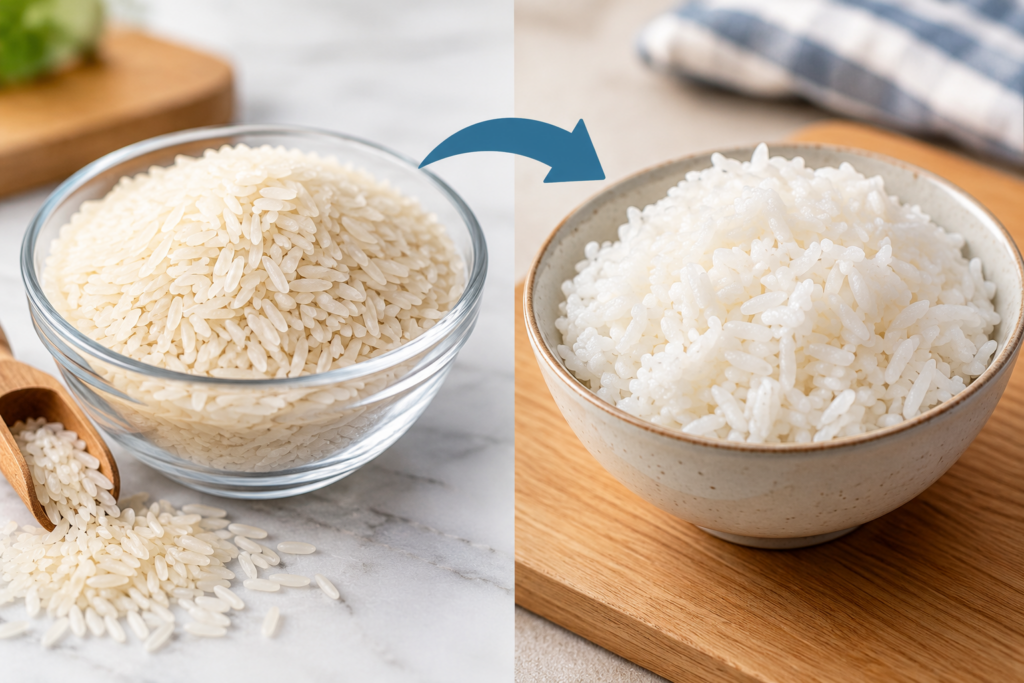
Cooked long-grain white rice is about 68% water, and dry rice is about 12%. Water adds weight but no calories, so 100 g of dry rice cooks to about 280 g with the same total calories. Some sources say cooking doesn’t change the calories in rice, which is true for the whole pot but not for each gram.
One dry cup has 675 calories and makes about 3.3 cups cooked. A package’s dry ¼-cup serving of 45 g (1.6 oz) has about 160–170 calories and cooks to about ¾ cup.
How Many Calories in a Cup of Rice or a Bowl?
One cup of cooked long-grain white rice has 205 calories, and a bowl has more or less depending on how much rice you put in it. In common portions of this rice, you’ll find these counts:
- Half cup: 103 calories in about 79 g (2.8 oz)
- One cup: 205 calories in 158 g (5.6 oz)
- One and a half cups: about 308 calories in 237 g (8.4 oz)
- Two cups: about 410 calories in 316 g (11.1 oz)
Some sources list 242 or 260 calories a cup since they use a 186 g or 200 g cup. The 1-2-3 ratio is a rounded rule: one cup of dry rice in two cups of water makes about three cups cooked. Five hundred calories is about 2 ⅓–2 ½ cups cooked or about ¾ cup dry (4.8 oz).
Calories in White Rice vs. Brown Rice
Long-grain white and brown rice contain these amounts per cooked cup:
| Nutrients per cooked cup | White long-grain, 1 cup (158 g) | Brown long-grain, 1 cup (202 g) |
|---|---|---|
| Calories | 205 | 248 |
| Carbs | 44.6 g | 51.7 g |
| Protein | 4.3 g | 5.5 g |
| Fat | 0.4 g | 2.0 g |
| Fiber | 0.6 g | 3.2 g |
Brown rice has more calories per cup because it weighs more, but per 100 g, it has 123 calories compared with 130 for white rice. In the 2008 reference tables, white rice has a glycemic index of 73, while brown rice has a value of 68. The value varies by variety.
Wild rice has the fewest calories per cooked cup of the five types, at 166, and the most protein, at 6.5 g.
Is Rice Good for Weight Loss?
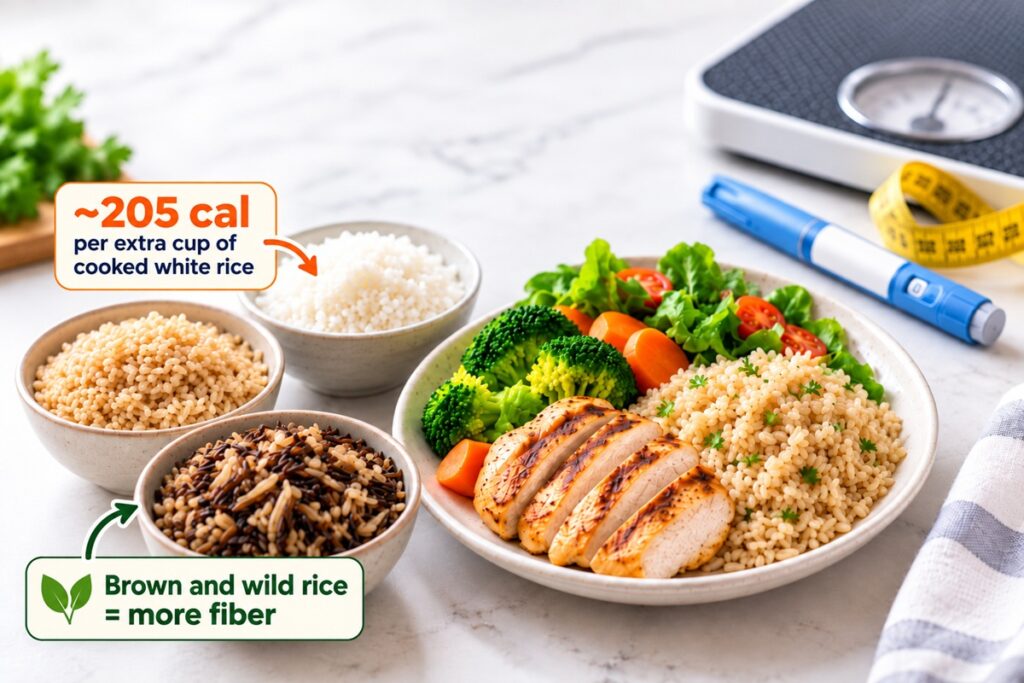
Rice can be good for weight loss when portions stay within your daily calorie target. Each extra cup of cooked white rice adds around 205 calories. Brown and wild rice provide more fiber, and federal guidelines favor whole grains.
If you take Ozempic or another GLP-1 medicine, your appetite for starchy foods often drops. A 2025 joint advisory on nutrition for people taking these medications encourages eating whole grains like brown rice and minimally processed foods.
Calories in Fried Rice
Fried rice has 174 calories per 100 g, while plain cooked white rice has 130 calories. The difference mainly comes from cooking oil, which can increase fat from about 0.3 g to 3.2 g per 100 g. A cup of fried rice has about 290–355 calories. Meatless fried rice is usually at the low end, and fried rice with pork is at the high end. Oil and sauce can increase the calorie count of stir-fry in the same way, as our calories in common meals such as a stir-fry show.
Does Cooling Cooked Rice Lower the Calories?
Cooling cooked rice doesn’t lower the calories by a measurable amount. A small 2015 trial with 15 adults found more resistant starch and a lower blood-sugar response in rice cooled for 24 hours and reheated. A 2013 study measured resistant starch in four white rices, then gave 21 adults the highest- and lowest-resistant-starch samples, both refrigerated for three days and reheated, and found no difference in blood-sugar response between them. Neither trial measured calories, and the extra resistant starch could remove about six calories a cup at most. Count leftover rice at the same calories as freshly cooked rice.
Refrigerate cooked rice within two hours, or within one hour when the air is above 90°F, and reheat leftovers to 165°F.
More Calorie Counts
- Calories in Chicken Breast
- Protein in Chicken Breast
- Banana Calories
- Calories in an Egg
- Apple Calories
- Big Mac Calories
- Calories in Strawberries
- Calories in Grapes
- Calories in Vodka
- Calories in a Slice of Pizza
- Baked Potato Calories
- Calories in Food: the full guide
Sources
- FoodData Central: white rice, long-grain, cooked (168878) and raw (168877); medium-grain, cooked (168880) and raw (168879); short-grain, raw (168881); brown rice, long-grain, cooked (169704) and raw (169703); wild rice, cooked (168897) and raw (169726), USDA, 2019
- FoodData Central: rice, white, cooked, FNDDS (2708408); fried rice, meatless (2708951), with chicken (2708953), with pork (2708954), and with shrimp (2708956), USDA, 2024
- Reference amounts customarily consumed, 21 CFR 101.12, 2026
- Effect of cooling of cooked white rice on resistant starch content and glycemic response, 2015
- Resistant starch in cooked, refrigerated white rice and glucose response, 2013
- International tables of glycemic index and glycemic load values, 2008
- Rice, The Nutrition Source, Harvard T.H. Chan School of Public Health, 2024
- Dietary Guidelines for Americans 2025–2030, USDA and HHS, 2026
- Preventing food poisoning, CDC, 2025
- Nutritional priorities to support GLP-1 therapy for obesity: joint advisory, 2025