
Key Takeaways
- Bananas, raw and peeled, generally contain 89 calories (372 kJ) per 100 g.
- A medium peeled banana at 118 g equals 105 calories (439 kJ).
- The 81–110 spread comes from different serving weights, rounding, and databases.
- Ripening barely moves the calorie total, except for green bananas eaten raw.
One hundred grams of raw peeled banana has 89 calories (372 kJ). A medium peeled banana at 118 g has 105 calories (439 kJ). The same fruit appears online as 81, 100, 105, and 110 calories. Each figure is accurate for a different weight or rule.
Parentheses show kilojoules.
Calories in a Banana by Size
| Size | Weight peeled | Calories (kJ) |
|---|---|---|
| Extra small (under 6 in.) | 2.9 oz (81 g) | 72 (301) |
| Small (6 to 6 ⅞ in.) | 3.6 oz (101 g) | 90 (377) |
| Medium (7 to 7 ⅞ in.) | 4.2 oz (118 g) | 105 (439) |
| Large (8 to 8 ⅞ in.) | 4.8 oz (136 g) | 121 (506) |
| Extra large (9 in. or longer) | 5.4 oz (152 g) | 135 (565) |
| FDA label “medium” | 4.4 oz (126 g) | 112 (469), label prints 110 |
| 1 cup sliced | 5.3 oz (150 g) | 134 (561) |
| 1 cup mashed | 7.9 oz (225 g) | 200 (837) |
The above figures come from USDA FoodData Central. The table is part of this food energy reference. For any other banana, multiply grams by 0.89. A 5 oz peeled banana is 142 g, so 126 calories (527 kJ).
USDA puts the peel at 36% of the whole fruit. Unpeeled, a medium banana is about 6.5 oz (184 g). A 5 oz, unpeeled banana holds about 91 g of fruit, 81 calories (339 kJ). The common foods table places the banana among snacks.
What to Eat on a GLP-1 When You Feel Sick
What to eat on Ozempic to avoid nausea is the same short list as what to eat on Mounjaro or Zepbound. The drug makers’ tips suggest crackers, toast, rice, and other bland, low-fat foods. They also say to split three meals into four or more, stop when you’re full, and avoid fatty food.
A medium banana in the table above is 118 g and 105 calories (439 kJ). By USDA figures, its 0.4 g of fat supplies about 3% of its calories. That fits the bland, low-fat description, but no label or drug maker’s tip names bananas for nausea. A small banana, 101 g and 90 calories (377 kJ), suits a smaller meal.
A 2025 advisory from four health societies suggests skipping fatty or high-fiber foods during the first few days of treatment. USDA lists 3.1 g of fiber in a medium banana. Five saltines, a slice of white toast, and a cup of cooked white rice each have 0.4 g to 0.6 g.
Wegovy’s label reports nausea in 44% of adults in weight-loss trials, against 16% on placebo. Zepbound’s gives 25% to 29% against 8%. In type 2 diabetes trials, Ozempic’s label gives 15.8% to 20.3% against 6.1%. Mounjaro’s gives 12% to 18% against 4%. In those trials, most nausea came during dose escalation, while the dose is being raised.
Severe, lasting abdominal pain, or vomiting or diarrhea that doesn’t stop, is a label warning sign and needs a clinician. Our page on GLP-1 side effects and how long nausea lasts has more advice.
Why One Banana Is 81, 100, 105, or 110 Calories
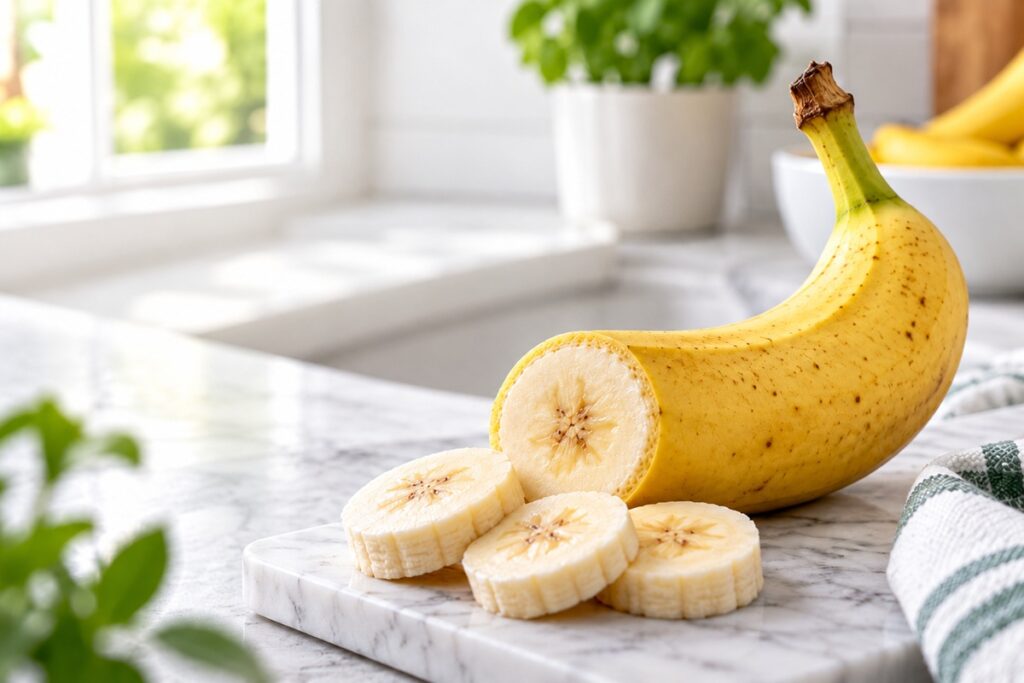
Banana calories differ by reference weight, label rounding, and database.
For example, the USDA uses a 118 g, peeled medium banana to end up with 105 calories (439 kJ). The FDA raw-produce figure is based on a 126 g medium banana is 112 calories (469 kJ), but it’s printed as 110 calories because labels round calories above 50 to the nearest 10.
However, one grower’s blog rounds 100 g of banana, generally 89 calories (372 kJ), up to 100 calories for a simpler, albeit less accurate, figure. Meanwhile, you may also see calories as low as 81 for a 100 g banana.
The point is sources differ, and peeled medium bananas generally fall between 81 and 110 calories. Each figure depends on whether it describes 100 g or a whole banana, and how it was rounded. This is one reason why, if you’re trying to manage weight or using a GLP-1 medication, and you’re counting calories, having a digital scale at home comes in handy.
Does a Ripe Banana Have More Calories?
Despite misconceptions, ripening leaves a banana’s calories nearly unchanged. Starch turns to sugar, so the taste and glycemic index change, but the calories do not.
USDA records put starch at 3.66 g per 100 g ripe and 0.41 g overripe, with total sugars at 15.8 g in both. A 2021 PLoS ONE study found that two standard ways of calculating calories gave the same result for ripe and overripe bananas. The calorie estimates for slightly ripe bananas differed by about 13 calories (54 kJ), depending on the calculation method.
A green banana eaten raw is an exception. The standard calculation counts its resistant starch as full energy, 114 calories (477 kJ) per medium banana. The study’s second calculation counts that starch as providing no energy, resulting in about 61 calories (255 kJ). This means your body absorbs way fewer calories from an unripe banana than a ripe one, even though both technically start with the same amount of energy.
What Else Is in a Medium Banana?
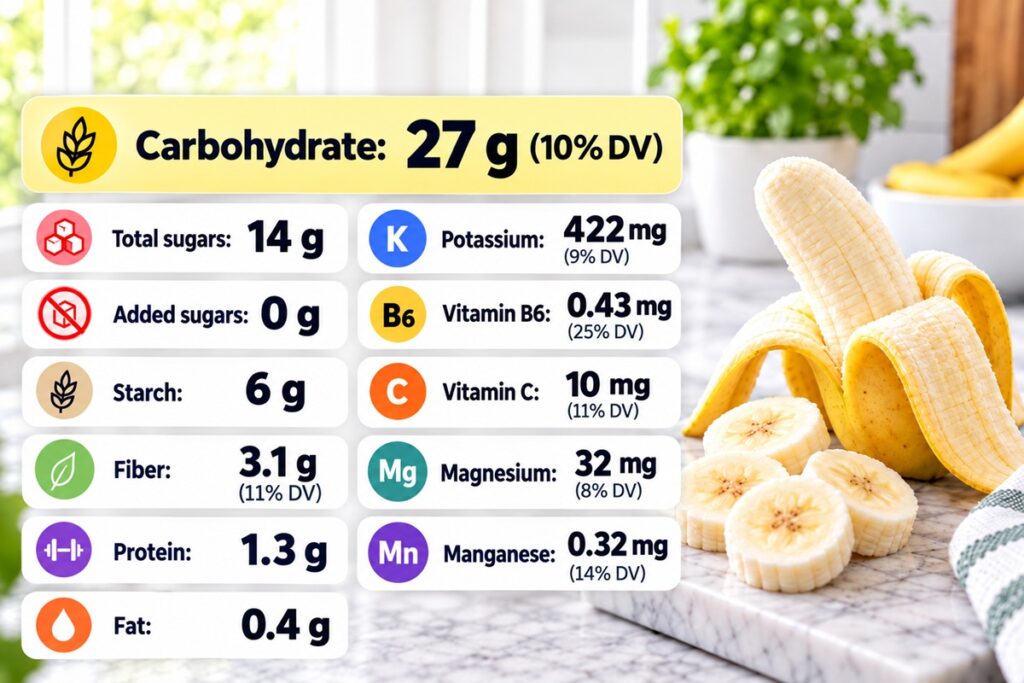
A 118 g, peeled medium banana gets almost all of its energy from carbohydrates.
- Carbohydrate: 27 g (10% DV)
- Total sugars: 14 g, added sugars 0 g
- Starch: 6 g
- Fiber: 3.1 g (11% DV)
- Protein: 1.3 g
- Fat: 0.4 g
- Potassium: 422 mg (9% DV)
- Vitamin B6: 0.43 mg (25% DV)
- Vitamin C: 10 mg (11% DV)
- Magnesium: 32 mg (8% DV)
- Manganese: 0.32 mg (14% DV)
FAQ
Is a Banana Good for Weight Loss?
A banana is good for weight loss only as far as whole fruit is in general. In three large US cohorts, each added daily serving of fruit was associated with half a pound less weight gain over four years. Bananas were among the fruits counted.
Is One Banana a Day Too Much Sugar?
One banana a day is not too much sugar by the only sugar limit on a US label. That limit covers added sugars, and a banana has none. Raw banana averages a glycemic index of 51, under the 55 low-GI threshold. Riper bananas tend to score higher than less ripe ones. A medium banana has around 27 g of carbohydrates, which is important for anyone counting carbs, such as those with diabetes.
Which Fruit Has the Lowest Calories?
The lowest-calorie fruit is not the banana, at 89 calories (372 kJ) per 100 g, compared with 52 calories (218 kJ) for an apple. Strawberries and watermelon sit lower still on the high-volume, low-calorie foods page, at about 32 and 30 calories per 100 g, among the lowest of common fruits.
Which Is Healthier, Apple or Banana?
Neither an apple nor a banana is healthier on every count. Per medium fruit, a 182 g apple is 95 calories (397 kJ) and a 118 g banana 105 calories (439 kJ). The apple has more fiber, 4.4 g compared with 3.1 g, and the banana more potassium, 422 mg to 195 mg.
How Many Calories Are There in Dried Banana or Banana Chips?
Dried bananas have 346 calories (1,448 kJ) per 100 g, about four times fresh fruit. A fresh banana is three-quarters water. Fried banana chips have 519 calories (2,171 kJ) per 100 g, or 147 calories (615 kJ) per ounce. For fresh banana, weigh the peeled banana and multiply grams by 0.89.
More Calorie Counts
- Calories in Chicken Breast
- Protein in Chicken Breast
- Calories in an Egg
- Apple Calories
- Big Mac Calories
- Calories in Strawberries
- Calories in Grapes
- Rice Calories
- Calories in Vodka
- Calories in a Slice of Pizza
- Baked Potato Calories
- Calories in Food: the full guide
Sources
- USDA FoodData Central, SR Legacy, Bananas, raw, FDC ID 173944, published April 2019. Per 100 g energy and nutrients, the household weights behind the size table, and the 36% peel share from SR28.
- USDA FoodData Central, Foundation Foods, Bananas, ripe and slightly ripe, raw, FDC ID 1105314, published April 2020. Starch and total sugars per 100 g for ripe fruit in the ripeness section.
- USDA FoodData Central, Foundation Foods, Bananas, overripe, raw, FDC ID 1105073, published April 2020. Starch and total sugars per 100 g for overripe fruit in the ripeness section.
- FDA, Nutrition Information for Raw Fruits, Vegetables, and Fish, Raw Fruits Poster, text version, content current as of 13 December 2017. The 126 g medium banana and its 110 calorie label figure.
- FDA, Daily Value on the Nutrition and Supplement Facts Labels, Daily Value page, content current as of 5 March 2024. Percent Daily Values in the nutrient list and the added sugars limit in the sugar FAQ.
- eCFR, 21 CFR 101.9(c)(1), current as of 1 September 2026. Label rounding of calories above 50 to the nearest 10.
- Phillips et al., Dietary fiber, starch, and sugars in bananas at different stages of ripeness in the retail market, PLoS ONE 2021, 16(7), e0253366. No energy difference between ripe and overripe, the 13 calorie slightly ripe gap, and the two green banana calculations.
- Atkinson, Foster-Powell, and Brand-Miller, International Tables of Glycemic Index and Glycemic Load Values, Diabetes Care 2008, 31(12), 2281 to 2283. Glycemic index of raw banana, 51 ± 3, in the sugar FAQ.
- Bertoia et al., Changes in intake of fruits and vegetables and weight change in United States men and women followed for up to 24 years, PLoS Medicine 2015, 12(9), e1001878. The three-cohort weight findings in the weight loss FAQ, from 133,468 adults followed up to 24 years.
- USDA FoodData Central, SR Legacy, Apples, raw, with skin, FDC ID 171688, published April 2019. Apple energy per 100 g and per 182 g medium fruit, with fiber and potassium, in the two fruit FAQs.
- USDA FoodData Central, SR Legacy, Bananas, dehydrated, or banana powder, FDC ID 173945, published April 2019. Dried banana energy per 100 g in the processed banana FAQ.
- USDA FoodData Central, SR Legacy, Snacks, banana chips, FDC ID 168849, published April 2019. Banana chip energy per 100 g and per ounce in the processed banana FAQ.
- FDA, DailyMed, Wegovy (semaglutide) injection full prescribing information, section 12.1, set ID f5e548d0-cc79-4c34-a3f5-e20a5b8b6564, effective 23 April 2024. GLP-1 as a regulator of appetite and caloric intake.
- Mozaffarian D, Agarwal M, et al. Nutritional priorities to support GLP-1 therapy for obesity: a joint Advisory from the American College of Lifestyle Medicine, the American Society for Nutrition, the Obesity Medicine Association, and The Obesity Society. Am J Clin Nutr. 2025 Jul;122(1):344-367. doi: 10.1016/j.ajcnut.2025.04.023. Epub 2025 May 30. Erratum in: Am J Clin Nutr. 2026 Jun;123(6):101303. doi: 10.1016/j.ajcnut.2026.101303. PMID: 40450457; PMCID: PMC12612741.