
Key Takeaways
- A medium apple with the skin on and core removed, about 6.4 oz, has 95 calories (397 kJ), or 52 calories (218 kJ) per 100 g.
- 100 g of raw apple with skin has 52 calories (218 kJ).
- A 5.7 oz (161 g) peeled, medium apple has 77 calories (322 kJ).
- 8 oz (236.6 mL) of unsweetened apple juice contains 114 calories (477 kJ).
The figure in parentheses after each calorie count is the same energy in kilojoules. Most of the spread between published apple figures comes from apple size or whether the weight includes the core or the skin. A whole medium apple, core and stem included, weighs about 7.1 oz (202 g).
Calories in a Small, Medium, and Large Apple
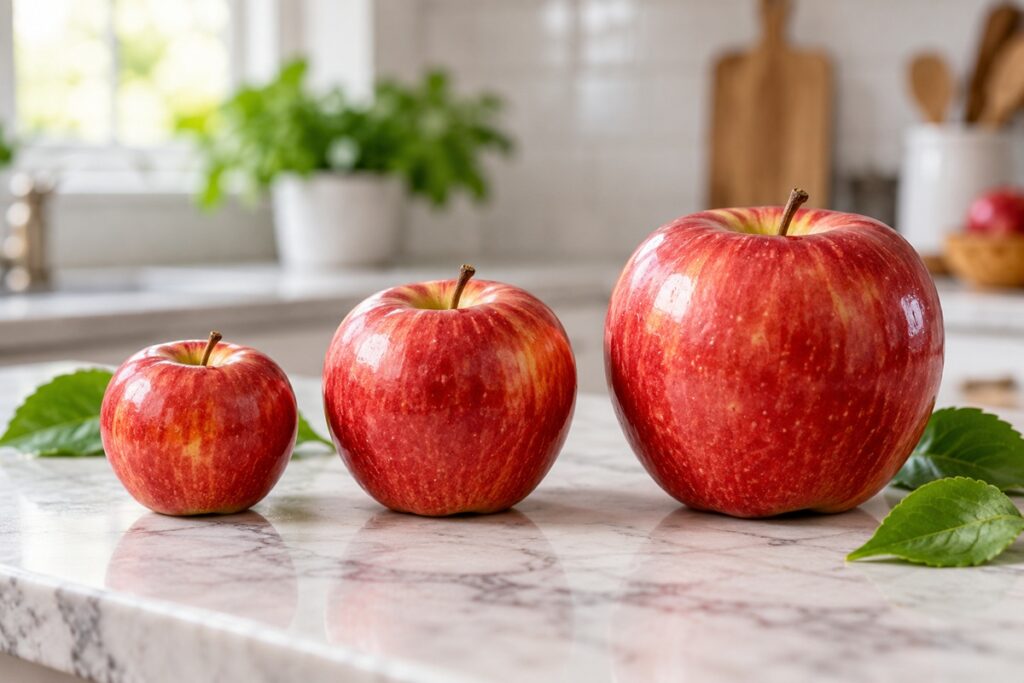
| USDA size (diameter) | Edible weight, oz (g) | Calories (kJ) |
|---|---|---|
| Extra small (2.5 in) | 3.6 oz (101 g) | 53 (222) |
| Small (2.75 in) | 5.3 oz (149 g) | 77 (322) |
| Medium (3 in) | 6.4 oz (182 g) | 95 (397) |
| Large (3.25 in) | 7.9 oz (223 g) | 116 (485) |
| 1 cup sliced | 3.8 oz (109 g) | 57 (238) |
| 1 cup quartered or chopped | 4.4 oz (125 g) | 65 (272) |
| FDA poster “1 large,” USDA NLEA serving | 8.5 oz (242 g) | 126 (527), printed as 130 |
Edible weight means core and stem removed, skin on. Multiply edible grams by 0.52 for calories, or whole-apple grams by 0.47. The table above still applies to people on a GLP-1 medication, which may lower appetite and intake.
The same medium apple meets the following nutrient counts:
- Carbohydrate: 25.1 g (9% DV)
- Fiber: 4.4 g (16% DV)
- Total sugars: 18.9 g, added sugars 0 g
- Potassium: 195 mg (4% DV)
- Vitamin C: 8.4 mg (9% DV)
- Protein: 0.5 g
- Fat: 0.3 g
About 96% of the energy comes from carbohydrates. You can compare apples with other snacks using the common foods table. Other single foods can be found in the food energy reference.
Where 52, 72, 77, 93, 116, and 130 Apple Calories Come From
| Figure | Weight, record, or rule |
|---|---|
| 52 | USDA per 100 g, raw apple with skin, edible portion |
| 72 | USDA’s 52 per 100 g applied to an older, lighter medium portion |
| 77 | USDA’s 5.3 oz small apple with skin, or its 5.7 oz peeled medium |
| 93 | USDA’s 6.4 oz medium rounded to 6.3 oz before multiplying |
| 95 | USDA’s 6.4 oz medium apple with skin, edible portion |
| 116 | USDA’s 7.9 oz large apple with skin, edible portion |
| 130 | FDA’s produce poster for an 8.5 oz large apple, declared to the nearest 10 |
Federal label rules round calories above 50 to the nearest 10, so the poster’s 126 calories (527 kJ) print as 130.
Calories in a Peeled Apple
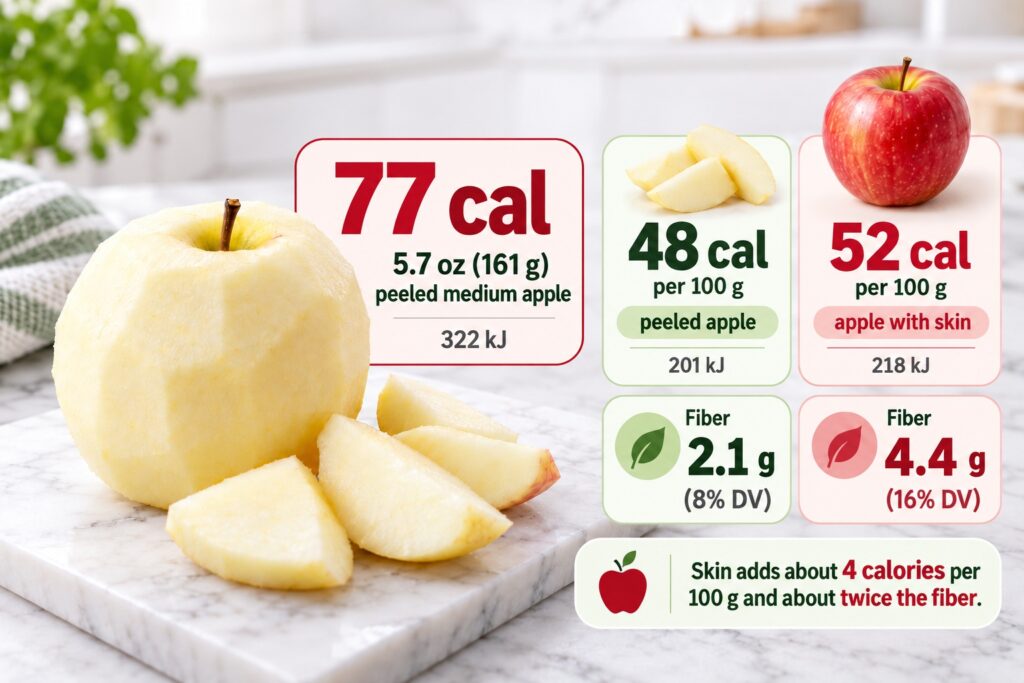
A 5.7 oz (161 g) peeled medium apple, with the core removed, has 77 calories (322 kJ). Per 100 g, a peeled apple contains 48 calories (201 kJ), and an apple with skin on has 52 calories (218 kJ).
Fiber equals 2.1 g (8% DV) in the peeled medium and 4.4 g (16% DV) with skin. The difference per 100 g is four calories and about half the fiber.
Do Apple Varieties Differ in Calories?
USDA’s five Foundation Foods variety records for apples, all with skin, differ by five calories per 100 g.
- Granny Smith: 53 calories (222 kJ)
- Honeycrisp: 54 calories (226 kJ)
- Gala: 55 calories (230 kJ)
- Red Delicious: 56 calories (234 kJ)
- Fuji: 58 calories (243 kJ)
The order follows total sugars from least to most, from 10.6 g per 100 g in Granny Smith to 13.3 g in Fuji. USDA’s archived SR Legacy variety pages read about 4% to 9% higher, which may be due to different samples and calculation methods.
Calories in Cooked Apple, Juice, Applesauce, and Dried Apple
| Form | USDA measure | Calories (kJ) | Per 100 g, calories (kJ) | Fiber |
|---|---|---|---|---|
| Apple, peeled, boiled | 1 cup sliced (171 g) | 91 (381) | 53 (222) | 4.1 g |
| Apple slices, canned, sweetened, heated | 1 cup (204 g) | 137 (573) | 67 (280) | 4.1 g |
| Apple juice, unsweetened | 8 oz cup (236.6 mL) | 114 (477) | 46 (192) | 0.5 g |
| Applesauce, unsweetened | 1 cup (244 g) | 102 (427) | 42 (176) | 2.7 g |
| Applesauce, sweetened | 1 cup (246 g) | 167 (699) | 68 (285) | 3.0 g |
| Dried apple rings, sulfured | 1 cup (86 g) | 209 (874) | 243 (1,017) | 7.5 g |
A cup of juice contains the energy of about 1.2 medium apples and 0.5 g of fiber. Its 24 g of sugar isn’t counted as added sugar on a US label, but the Dietary Guidelines for Americans advise getting most fruit from whole fruit rather than juice.
FAQ
How Many Calories Are in One Apple?
Based on USDA figures, one medium apple with skin has 95 calories (397 kJ). A small, 5.3 oz (149 g) apple has 77 calories (322 kJ), and a large, 7.9 oz (223 g) apple has 116 calories (485 kJ). Core the apple before it goes on the scale, and 52 calories (218 kJ) per 100 g holds. For a whole apple, count nine-tenths of its weight.
Is One Apple a Day Too Much Sugar?
One medium apple a day has 18.9 g of total sugar and 0 g of added sugar. Added sugars are the only sugar with a Daily Value on a US label, 50 g. Fructose is 10.7 g of the total. Glycemic index measures how fast a food raises blood sugar. Raw apple scores 36, and 55 or under counts as low. Two medium apples have 190 calories (795 kJ), 37.8 g of total sugars, and 8.7 g of fiber.
Is Apple Good for Weight Loss?
Apples can be good for weight loss when combined with a low-fat and low-calorie diet and exercise. According to the USDA, one 6.4 oz medium apple with skin counts as 95 calories (397 kJ). Weight change depends on total energy in against energy out. In an observational study of US health professionals, each added daily serving of apples and pears combined was linked to 1.24 lb less weight gain over four years.
What Fruit Is Lowest in Calories?
The fruit lowest in calories is watermelon, at 30 calories (126 kJ) per 100 g. Strawberries have 32 calories (134 kJ) per 100 g, also below the apple’s 52 calories (218 kJ). Blueberries at 57 calories (238 kJ) and bananas at 89 calories (372 kJ) per 100 g sit above it. See the high-volume foods list for data on additional fruits.
More Calorie Counts
- Calories in Chicken Breast
- Protein in Chicken Breast
- Banana Calories
- Calories in an Egg
- Big Mac Calories
- Calories in Strawberries
- Calories in Grapes
- Rice Calories
- Calories in Vodka
- Calories in a Slice of Pizza
- Baked Potato Calories
- Calories in Food: the full guide
Sources
- USDA FDC 171688, raw apple, SR Legacy “Apples, raw, with skin”, updated 2019, with the SR28 refuse figure of 10% for core and stem; supports the 52 per 100 g base, the size and cup portions, the whole-apple weight, the medium-apple nutrients, and the 130 arithmetic.
- USDA FDC 171689, peeled apple, SR Legacy “Apples, raw, without skin”, updated 2019; supports the peeled figures and the 161 g peeled medium.
- USDA FDC 1750342, Granny Smith, Foundation Foods, updated 2020; supports the Granny Smith energy and sugars.
- USDA FDC 1750343, Honeycrisp, Foundation Foods, updated 2020; supports the Honeycrisp energy.
- USDA FDC 1750341, Gala, Foundation Foods, updated 2020; supports the Gala energy.
- USDA FDC 1750339, Red Delicious, Foundation Foods, updated 2020; supports the Red Delicious energy.
- USDA FDC 1750340, Fuji, Foundation Foods, updated 2020; supports the Fuji energy and sugars.
- USDA FDC 173933, apple juice, SR Legacy “Apple juice, canned or bottled, unsweetened”, 2008 data; supports the juice figures and the 248 g cup.
- USDA FDC 171695, unsweetened applesauce, SR Legacy “Applesauce, canned, unsweetened”, 2008 data; supports the unsweetened applesauce figures.
- USDA FDC 171696, sweetened applesauce, SR Legacy “Applesauce, canned, sweetened, without salt”; supports the sweetened applesauce figures.
- USDA FDC 171691, dried apple, SR Legacy “Apples, dried, sulfured, uncooked”, values dated 1982; supports the dried apple figures and the 86 g cup.
- USDA FDC 173928, boiled apple, SR Legacy “Apples, raw, without skin, cooked, boiled”, 1982 data; supports the boiled apple figures and the 171 g cup.
- USDA FDC 173930, canned apple, SR Legacy “Apples, canned, sweetened, sliced, drained, heated”, 1982 data; supports the canned apple figures and the 204 g cup.
- FDA Raw Fruits Poster, text version, content current as of December 13, 2017; supports the 130 calories for a 242 g large apple.
- 21 CFR 101.9, calorie rounding, eCFR edition of September 16, 2026; supports the nearest-10 rule behind 130.
- FDA Daily Values, current as of March 5, 2024; supports every %DV figure and the 50 g added sugars value.
- Atkinson et al. 2008, “International Tables of Glycemic Index and Glycemic Load Values: 2008”, Diabetes Care; supports the glycemic index of 36 for raw apple and the 55 low-GI threshold.
- Bertoia et al. 2015, PLoS Medicine, three US cohorts followed 1986 to 2010; supports the apples and pears association of 1.24 lb less weight gain per added daily serving over four years.
- FDA Wegovy label, §12.1, Novo Nordisk prescribing information effective June 18, 2026; supports the sentence on appetite and intake.