
Key Takeaways
- A 50 g shelled large egg has 72 calories (301 kJ).
- A hard-boiled large egg equals 78 calories (326 kJ).
- Two large eggs have 144 calories (602 kJ).
A 50 g shelled large egg is 72 calories (301 kJ), or 143 calories (598 kJ) per 100 g. Kilojoules, the metric energy unit, follow in parentheses.
Egg Calories by Size
| Size (oz/dozen) | Shelled weight | Calories (kJ) |
|---|---|---|
| Small (18) | 1.3 oz (38 g) | 54 (226) |
| Medium (21) | 1.6 oz (44 g) | 63 (264) |
| Large (24) | 1.8 oz (50 g) | 72 (301) |
| Extra large (27) | 2.0 oz (56 g) | 80 (335) |
| Jumbo (30) | 2.2 oz (63 g) | 90 (377) |
The shell makes up 12% of the egg, and a large egg weighs about 57 g, or around 2 oz in the shell, which matches USDA’s large class minimum of 24 oz per dozen, and about 50 g once the shell is removed. A large egg has 6.3 g protein, 4.8 g fat, 27% DV choline, 28% selenium, and 19% B12. The common foods table and food energy reference cover other foods.
Eggs and Breakfast on a GLP-1
For what to eat on GLP-1, the eggs in the table above are among the lower-volume (small-serving) protein foods a 2025 GLP-1 nutrition advisory encourages.
The Wegovy label says the drug acts on appetite and calorie intake, so meals tend to get smaller. The advisory links nausea to mornings and long gaps without food. People can be counseled to eat a small breakfast, then small meals every 3–4 hours.
USDA’s small egg has 4.8 g protein and 3.6 g fat, and its jumbo 7.9 g and 6.0 g. Two large eggs give 144 calories (602 kJ) and 12.6 g protein, about 10–16% of the advisory’s 80–120 g a day.
A whole egg exceeds the FDA “low fat” limit of 3 g per 50 g. The white is fat-free, with 3.6 g protein and 17 calories (71 kJ). Among foods to eat on Zepbound, its nausea tips name toast, crackers, and rice, and they name butter and cheese as fatty foods to avoid. A teaspoon of butter adds 3.8 g fat and 34 calories (142 kJ). High-protein or high-fat foods may worsen constipation, the advisory says.
The common foods page covers food on a GLP-1 across a full day.
Why an Egg Can Have 70, 72, 74, 78, or 80 Calories
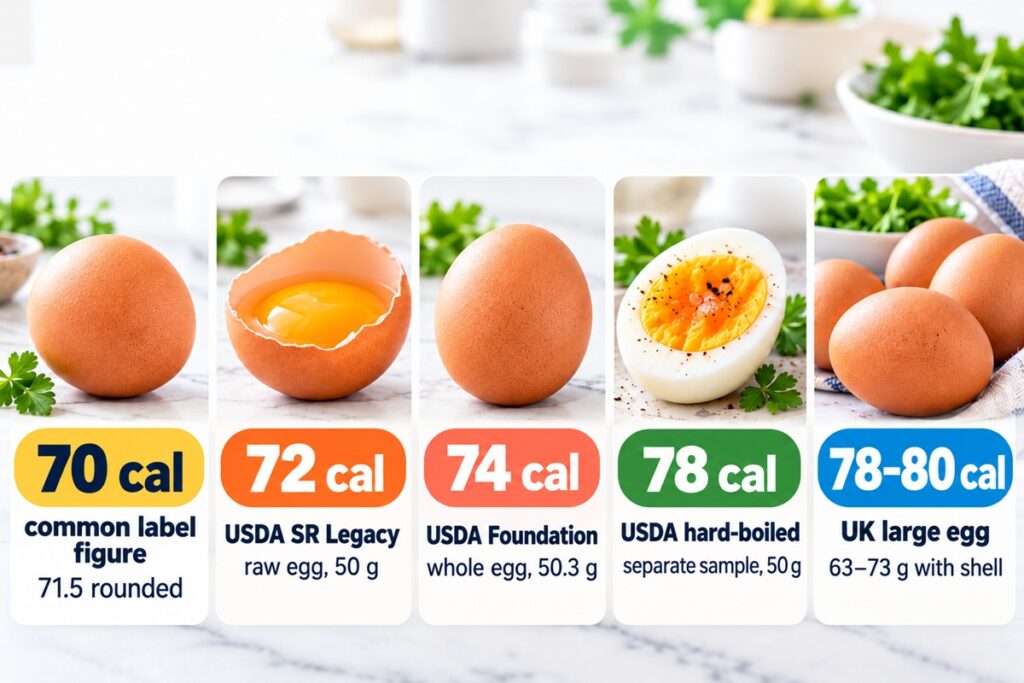
- 70 calories represents the most common label figure, 71.5 rounded to the nearest 10.
- 72 calories comes from a USDA SR Legacy (an archived figure) raw egg at 50 g.
- 74 calories comes from a USDA Foundation whole egg at 50.3 g by egg-specific factors.
- 78 calories represents a USDA hard-boiled egg, a separate sample, at 50 g.
- 78–80 calories is a UK large egg, generally equaling a US extra-large egg, graded with the shell on, at 63 to 73 g.
Calories in a Boiled, Poached, Fried, or Scrambled Egg
| Method | USDA portion | Calories (kJ) |
|---|---|---|
| Raw or poached | 50 g | 72 (301) |
| Hard-boiled | 50 g | 78 (326) |
| Fried | 46 g | 90 (377) |
| Scrambled | 61 g | 91 (381) |
A boiled egg totals 78 calories because USDA’s hard-boiled sample has less water and more fat. Boiling adds nothing. A teaspoon of oil adds 40 calories (167 kJ), and a teaspoon of butter 34 calories (142 kJ).
Calories in Egg White, Yolk, and Liquid Egg
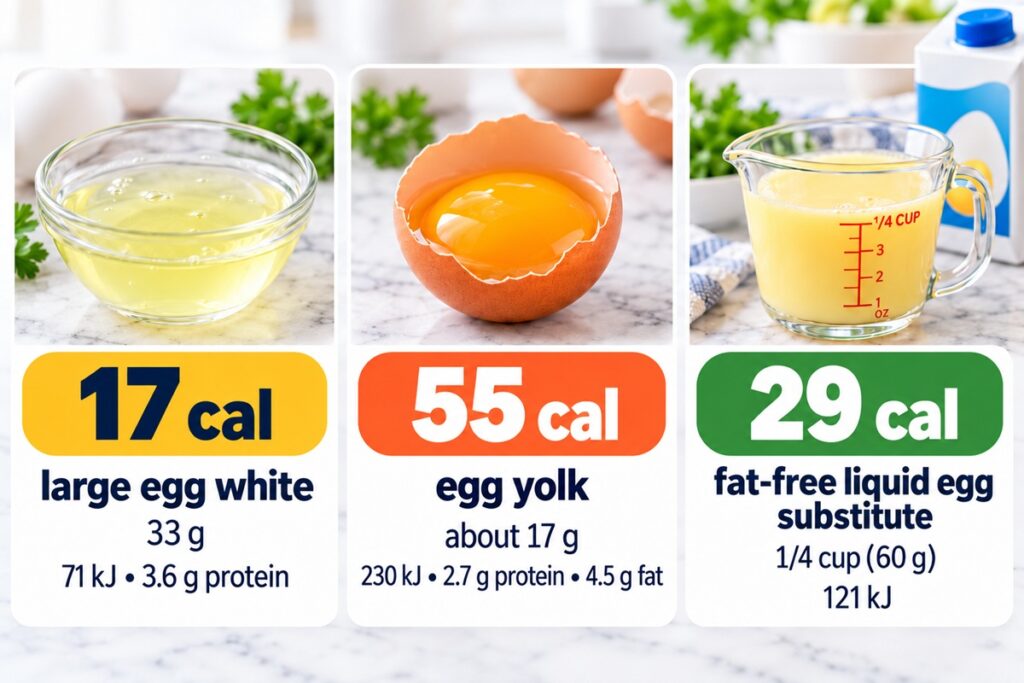
- A large egg white, 33 g, has 17 calories (71 kJ) and 3.6 g protein.
- Egg yolk, usually weighing around 17 g, has 55 calories (230 kJ), 2.7 g of protein, and 4.5 g of fat.
- Fat-free liquid egg substitute has 29 calories (121 kJ) per 1/4 cup (60 g).
- Carton whites and whole liquid eggs follow their own label.
FAQ
Are Two Eggs a Day Too Much Fat?
Two large eggs have 9.5 g of fat (12% DV) and 372 mg of cholesterol (124%). That includes 3.1 g of saturated fat (16% DV). Large observational studies generally don’t link dietary cholesterol with heart disease, although a higher-than-average intake may raise LDL cholesterol.
How Many Calories Are in Two Eggs?
Two large eggs have 144 calories (602 kJ) raw or poached, and three have 216 calories (904 kJ).
How Much Protein and Calories Are in Each Egg?
Each large egg has 6.3 g of protein and 72 calories (301 kJ).
Are Eggs Okay for Weight Loss?
Eggs can work in a weight-loss diet because they contain protein and very little carbohydrates. However, weight changes depend on total calories over time, not any single food.
More Calorie Counts
- Calories in Chicken Breast
- High Protein Low Calorie Foods
- High Protein Breakfast
- Protein in Chicken Breast
- Banana Calories
- Apple Calories
- Big Mac Calories
- Calories in Strawberries
- Calories in Grapes
- Rice Calories
- Calories in Vodka
- High-Volume, Low-Calorie Foods
- Calories in a Slice of Pizza
- Baked Potato Calories
- Calories in Food: the full guide
Sources
- USDA FDC 171287, raw egg, SR Legacy “Egg, whole, raw, fresh”, updated 2019; supports the 143 per 100 g base, the size portions, the large-egg nutrients, and the 12% shell share from SR28.
- USDA FDC 173424, hard-boiled egg, SR Legacy, updated 2019; supports the 78 figure and the separate-sample note.
- USDA FDC 172186, poached egg, SR Legacy, updated 2019; supports poached equal to raw at 50 g.
- USDA FDC 173423, fried egg, SR Legacy, updated 2019; supports the fried figure and the 46 g portion.
- USDA FDC 172187, scrambled egg, SR Legacy, updated 2019; supports the scrambled figure and the 61 g portion.
- USDA FDC 172183, egg white, SR Legacy, updated 2019; supports the white energy and protein.
- USDA FDC 172184, egg yolk, SR Legacy, updated 2019; supports the yolk energy, protein, and fat.
- USDA FDC 173462, egg substitute, SR Legacy “Egg substitute, liquid or frozen, fat free”, updated 2019; supports the 1/4 cup energy figure.
- USDA FDC 748967, Foundation egg, Foundation Foods “Eggs, Grade A, Large, egg whole”, updated 2019; supports the 74 explanation.
- USDA AMS 56 weight classes, United States Standards, Grades, and Weight Classes for Shell Eggs, effective July 20, 2000; supports ounces per dozen by size.
- EC Regulation 589/2008, Article 4, Commission Regulation (EC) No 589/2008 as retained UK law, “Grading of Class A eggs by weight”, retrieved September 18, 2026; supports the UK large class of 63 to 73 g in the shell.
- 21 CFR 101.9, calorie rounding, eCFR edition of September 16, 2026; supports the label figure of 70.
- 21 CFR 101.12, serving size, eCFR edition of September 16, 2026; supports the 50 g reference amount behind the label figure.
- FDA Daily Values, current as of March 5, 2024; supports every %DV figure.
- Carson JAS et al., Dietary Cholesterol and Cardiovascular Risk: A Science Advisory From the American Heart Association, Circulation 2020;141(3):e39-e53, https://doi.org/10.1161/CIR.0000000000000743; supports the cholesterol context in the two-eggs FAQ.
- USDA FDC 173410, butter, SR Legacy “Butter, salted”, updated 2019; supports the teaspoon of butter figure.
- USDA FDC 171413, olive oil, SR Legacy “Oil, olive, salad or cooking”, updated 2019; supports the teaspoon of oil figure.
- FDA Wegovy label, §12.1, prescribing information effective June 18, 2026; supports the sentence on appetite and intake.