
A cup (151 g) of red or green seedless grapes has 104 calories. One grape has about 3.4 calories, and 100 g has 69.
Some sources list 62 calories per cup, weighing only 92 g, but that figure applies to a specific type of grape. Most grapes weigh more than that.
You’ll find more figures like these in our calorie counts for everyday foods.
Calories in Grapes by Count, Cup, and Weight
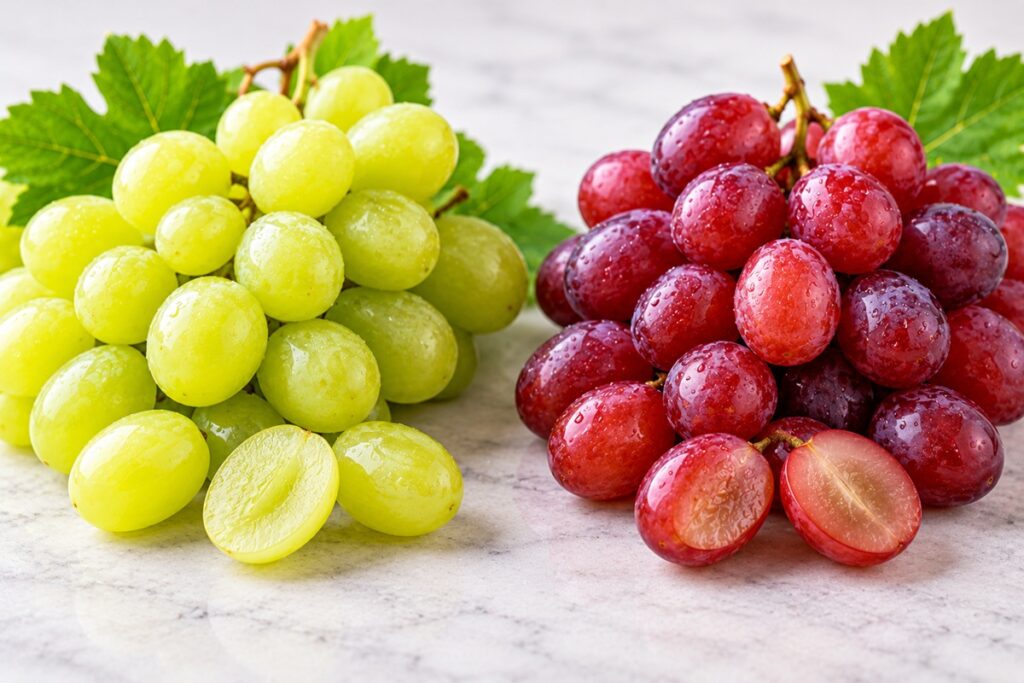
These figures represent fresh seedless red or green grapes, the kind sold in bags and clamshells. Find your portion in this table:
| Serving | Weight | Calories | kJ |
|---|---|---|---|
| 1 grape | 4.9 g | 3.4 | 14 |
| 1 oz | 28 g | 20 | 82 |
| 10 grapes | 49 g | 34 | 141 |
| 15 grapes | 73.5 g | 51 | 212 |
| ½ cup | 76 g | 52 | 217 |
| 20 grapes | 98 g | 68 | 282 |
| 100 g | 100 g | 69 | 288 |
| ¾ cup | 126 g | 87 | 363 |
| 30 grapes | 147 g | about 101 | about 423 |
| 1 cup | 151 g | 104 | 435 |
| 1 pound | 454 g | 313 | 1,306 |
The rows representing one cup, 10 grapes, and 126 g serve weights from the federal food database. On the FDA’s produce label, the ¾-cup (126 g) serving shows 90 calories, rounded from 87.
We calculated the other rows from 69 calories per 100 g. The per-grape weight is based on the 10-grape weight divided by 10, but actual grapes vary in size.
Thirty seedless grapes add up to about 100 calories when your grapes are close to the 4.9 g average. You’ll get a more accurate estimate by weighing the portion when your grapes look much larger or smaller than that average.
Counting works well when you eat a few grapes at your desk. Weighing works better when you fill a bowl or eat from a bag.
Why a Cup of Grapes Can Be 62, 104, or 125 Calories
Each figure comes from a different federal food-database entry, with its own grape and cup weights:
| Grape entry | Weight of one grape | Weight of one cup | Calories per cup |
|---|---|---|---|
| Slip-skin, Concord type | 2.4 g | 92 g | 62 |
| Seedless red or green | 4.9 g average from 10 grapes or 49 g | 151 g | 104 |
| Newest survey entry for raw grapes | 7 g | 150 g | about 125 |
One slip-skin grape has about 1.6 calories, so 10 have about 16. The number of grapes that make up 100 calories depends on their size. It takes about 62 slip-skin grapes, about 30 seedless grapes, or about 17 of the survey entry’s 7 g grapes. USDA publishes all three cup weights without explaining why the cups weigh different amounts. Grape size and packing are the likely reasons, since one slip-skin grape weighs 2.4 g, while the survey entry assumes each grape weighs 7 g.
The newest survey figure is also higher per 100 g. The samples behind it contained a little more carbohydrate and less water. That entry also counts each gram of carbohydrate as four calories, unlike the older entry. When you log grapes, pick the entry that matches the grapes in your bowl, not the first cup figure you find.
Red, Green, and Black Grapes Compared
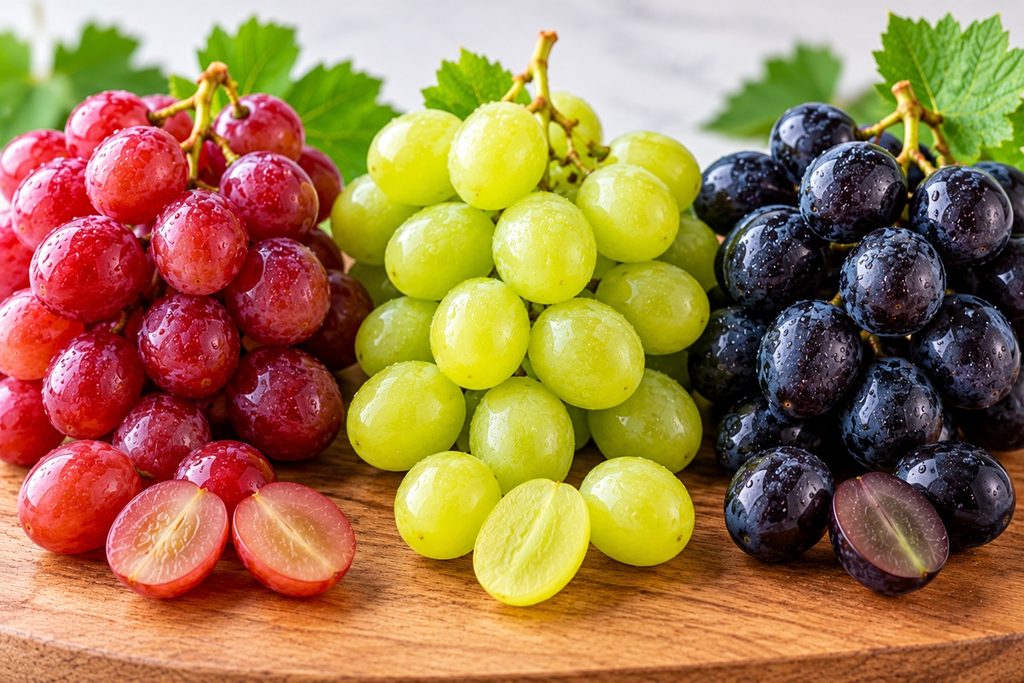
The older seedless entry combines red and green grapes at 69 calories per 100 g. Newer federal entries list them separately, at 77 calories per 100 g for red seedless grapes and 72 calories for green seedless grapes. A 151 g cup comes to about 117 calories for red and about 109 for green.
The difference is small, and each color comes from only eight samples, so don’t treat it as a rule. At a difference of about eight calories per cup between red and green grapes, the color you pick makes little difference to your daily total.
USDA lists no entry for black table grapes. Black seedless table grapes belong to the same species as red and green ones, so the seedless red or green figure is your closest estimate.
Muscadine grapes have fewer calories, at 57 per 100 g, and more fiber, at 3.9 g. One 6 g muscadine has about 3.4 calories, so about 29 of them make 100 calories.
Cotton candy grapes have no calorie figure from the grower or from USDA, so treat them as seedless green grapes until someone publishes one.
Carbs, Sugar, Fiber, and Vitamins in a Cup of Grapes
Note the follow nutrition information for one cup of seedless red or green grapes (151 g):
- Calories: 104
- Carbohydrate: 27.3 g
- Sugars: 23.4 g, almost all-natural glucose and fructose
- Fiber: 1.4 g
- Protein: 1.1 g
- Fat: 0.2 g
- Water: about 81% of the weight
- Potassium: 288 mg, 6% of the Daily Value
- Vitamin C: 4.8 mg, 5% of the Daily Value
- Vitamin K: 22 µg (micrograms), 18% of the Daily Value
- Copper: 0.19 mg, 21% of the Daily Value
Grapes have almost no protein or fat, so their calories come almost entirely from sugar. Those sugar calories count in your daily total even though none of the sugar is “added.” For a smaller portion, 10 grapes have 8.9 g of carbohydrates and 7.6 g of sugar.
Glycemic Index of Grapes and Blood Sugar
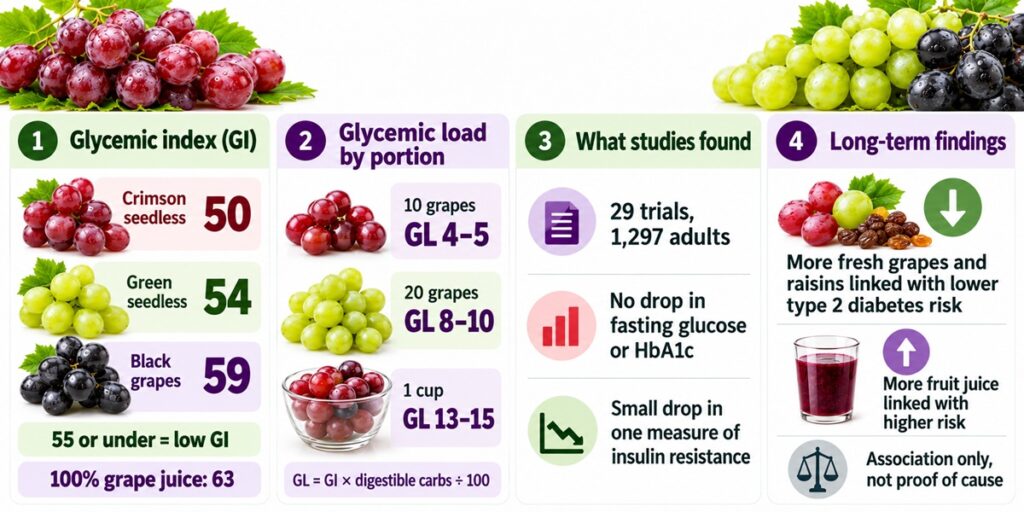
In studies of healthy people, grapes score 50–59 on the glycemic index, which measures how much a food raises blood sugar compared with pure glucose. Crimson seedless grapes scored 50, green seedless 54, and black grapes 59.
A score of 55 or under counts as low, so black grapes score just above that line. One test of 100% grape juice in healthy people gave it a higher score of 63.
Glycemic load takes your portion into account: It’s the glycemic index multiplied by the grams of digestible carbohydrate you eat, divided by 100. By our calculation, the load is between four to five for 10 grapes, eight to 10 for 20 grapes, and 13 to 15 for a full cup.
A 2021 review combined 29 trials that gave 1,297 adults grapes or grape products. Fasting glucose and HbA1c, a longer-term blood sugar marker, didn’t fall in those trials. They did however show a small drop in one measure of insulin resistance.
Three long-term US studies followed about 187,000 health professionals. Those who ate more fresh grapes and raisins had a lower risk of type 2 diabetes. Those who drank more fruit juice had a higher risk. That’s an association, not proof of cause.
Grapes as a Snack When You’re Counting Calories
Twenty grapes contain 68 calories, and a full cup contains 104 calories. You can eat either portion quickly because grapes need no peeling, no cutting, and no plate.
You’ll find it hard to judge the amount when you eat from the bag while you cook or watch television. Two cups eaten that way add 208 calories, about three times what 20 grapes add. Counting out 10, 20, or 30 grapes gives you a portion you can log without weighing fruit.
If you’re looking for the best snacks on Ozempic, grapes fit general GLP-1 eating advice, which focuses on fruits and other minimally processed foods. The Wegovy label says semaglutide lowers calorie intake, probably by affecting appetite.
A 2025 nutrition advisory for people on GLP-1 medication encourages minimally processed foods such as fruits, vegetables, whole grains, and legumes, and suggests small, frequent meals when hunger is low.
The same advisory makes protein a priority, and a cup of grapes has only 1.1 g. Have them with protein, not instead of protein.
See how grapes compare to other foods in our guide on high-volume, low-calorie foods.
Do Frozen Grapes Have Fewer Calories?
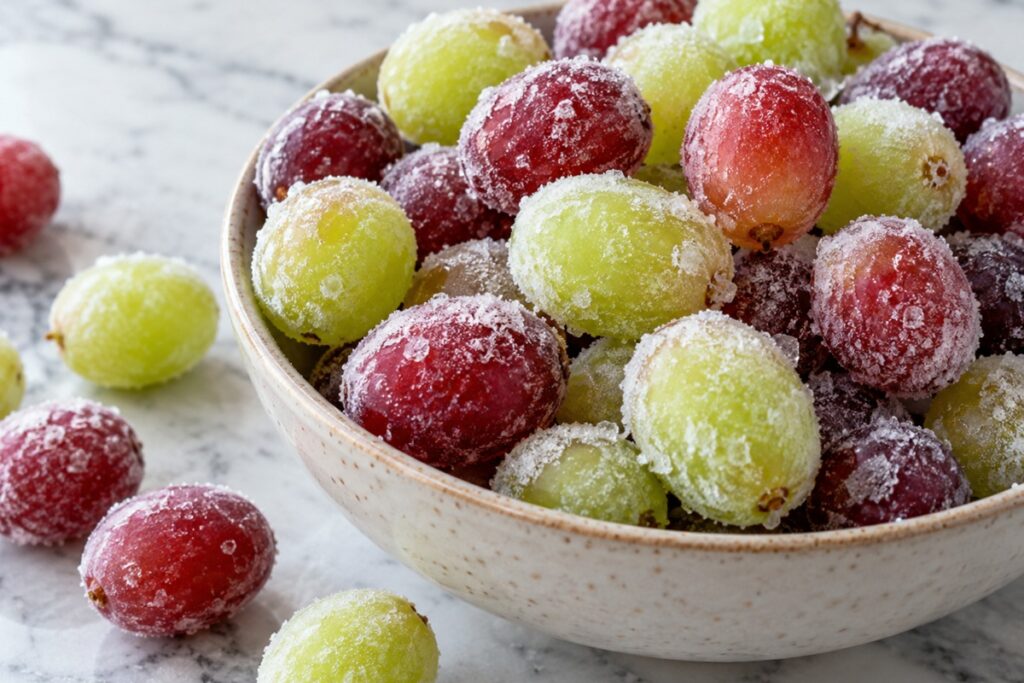
Frozen grapes don’t have fewer calories than fresh grapes; they have the same. Freezing adds nothing and removes nothing, so 10 frozen grapes still contain 34 calories.
Federal food-safety guidance states that freezing doesn’t destroy nutrients, and USDA’s food database has no separate frozen-grape entry, so use the fresh figure.
Count or weigh frozen grapes rather than scooping them by the cup because USDA doesn’t publish a cup weight for frozen grapes. Plain grapes frozen at home contain no added sugar. Grapes frozen in syrup contain added sugar from the syrup, so log them as a separate food.
Raisins vs. Grapes: Same Fruit, About Four Times the Calories per Ounce
Drying removes water while the calories stay in the fruit. Fresh grapes have 80.5 g of water per 100 g, and dark raisins have 15.5 g. That leaves 19.5 g of solids in grapes and 84.5 g in raisins, about 4.3 times as much. Calories rise by the same factor, from 69 to 299 per 100 g.
A 151 g cup of grapes, with 104 calories, would dry into about ¼ cup of raisins, which has about 108 calories. A 1.5 oz small box of raisins contains 129 calories, about the same as 1¼ cups of fresh grapes.
Here are the calories and sugars in common raisin portions:
| Raisin serving | Weight | Calories | Sugars |
|---|---|---|---|
| 1 raisin | 0.5 g | 1.5 | 0.3 g |
| Miniature box, 0.5 oz | 14 g | 42 | 9.1 g |
| 50 raisins | 26 g | 78 | 17 g |
| 1 oz, about 60 raisins | 28 g | 85 | 18.5 g |
| ¼ cup | 36 g | about 108 | about 23.5 g |
| Small box, 1.5 oz | 43 g | 129 | 28 g |
| 1 cup, not packed | 145 g | 434 | 94.5 g |
| 1 cup, packed | 165 g | 493 | 107.6 g |
Golden raisins are almost the same, at 301 calories per 100 g, 436 in an unpacked cup, and 497 in a packed one. For 100 calories, you get 145 g of grapes but only 33 g of raisins. A small box of raisins also has 1.9 g of fiber.
Grape Juice and Canned Grapes
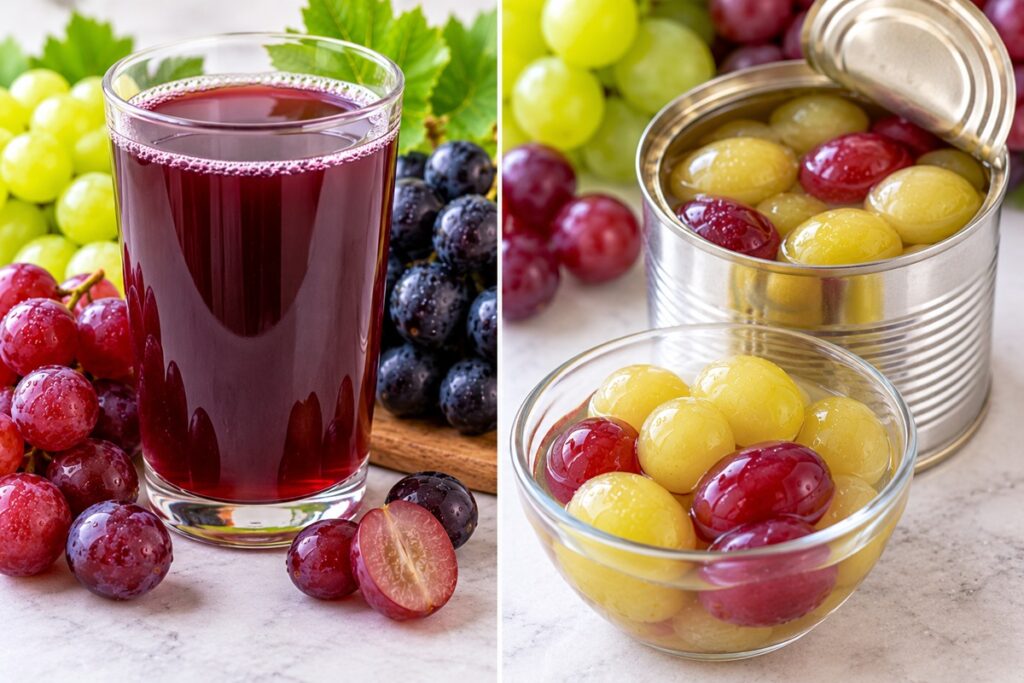
A cup of unsweetened grape juice (8 fl oz, 253 g) contains 152 calories, 35.9 g of sugars, and 0.5 g of fiber. A cup of fresh grapes contains 104 calories, 23.4 g of sugars, and 1.4 g of fiber. The juice gives you more calories, more sugar, and less fiber in the same cup. A small 4 fl oz glass of unsweetened juice contains 76 calories, and each fluid ounce adds 19.
A 100% grape juice blend has about 164 calories per 8 fl oz. A 6.75 fl oz juice box has about 138 calories when it’s 100% juice.
The calories in canned grapes depend on the liquid they’re packed in. A cup of canned Thompson seedless grapes in water (245 g, fruit and liquid) contains 98 calories. A cup of grapes in heavy syrup (256 g) contains 195 calories because the syrup adds sugar.
Check whether the can says water or heavy syrup and pick the matching entry, since the two differ by about 100 calories a cup.
Health Benefits of Grapes and What the Studies Tested
Grape trials on blood pressure and cholesterol mostly used powder, extract, or juice in adults with raised heart risk. A 2015 review of 10 trials, mostly of extracts and powder, found systolic blood pressure, the upper number, about 1.5 mmHg (millimeters of mercury) lower.
A 2020 review of 24 powder, juice, and extract trials found LDL cholesterol about 6 mg/dL lower, and none of those trials used fresh grapes. Those results don’t show that fresh grapes do the same.
One trial did test fresh grapes in 69 adults who had high cholesterol. They ate 500 g daily for eight weeks, about 3⅓ cups and 345 calories a day. Total and LDL cholesterol fell with the red grapes but not with the white.
In a separate analysis of three long-term US studies, covering about 133,000 adults, people who ate more grapes and raisins gained less weight over time. That link doesn’t prove the grapes caused it.
A cup of grapes contains about 0.25 mg of resveratrol, a plant compound also tested as a supplement. A two-year crossover trial in postmenopausal women, with 12 months on resveratrol, gave 150 mg a day, the amount in about 600 cups.
Some sources say grapes prevent cancer, slow aging, ease inflammation, or help your skin, sleep, or gut. None of these claims is proven in people. When you read about a grape study, check whether it tested fresh fruit, powder, juice, or a supplement.
More Calorie Counts
- Calories in Chicken Breast
- Protein in Chicken Breast
- Banana Calories
- Calories in an Egg
- Apple Calories
- Big Mac Calories
- Calories in Strawberries
- Rice Calories
- Calories in Vodka
- Calories in a Slice of Pizza
- Baked Potato Calories
- Calories in Food: the full guide
Sources
- FoodData Central: grapes, red or green, raw (174683) and American type, slip skin, raw (174682), USDA, 2019
- FoodData Central: grapes, red seedless (2346412) and green seedless (2346413), USDA, 2022; grapes, raw (FNDDS 2709237) and grape juice, 100% (FNDDS 2709325), USDA, 2024
- FoodData Central: grapes, muscadine (173040), raisins, dark (168165) and golden (168164), grape juice, unsweetened (173042), and canned grapes, water pack (174684) and heavy syrup (174685), USDA, 2019
- Raw Fruits Poster, FDA, 2017
- Freezing and Food Safety, USDA FSIS, 2024
- Freezing Grapes, National Center for Home Food Preservation, 2014
- Wegovy prescribing information, 2026
- Nutritional priorities to support GLP-1 therapy for obesity: joint advisory, 2025
- International tables of glycemic index and glycemic load values, 2008; University of Sydney GI database, 2026
- Grape-product reviews: blood pressure, 2015; blood lipids, 2020; glucose and insulin, 2021
- Fresh red and white grapes and cholesterol, 2015; fruit intake and type 2 diabetes, 2013; fruit and weight change, 2015
- Phenol-Explorer resveratrol data, 2026; resveratrol and bone density, 2020; Daily Values, 21 CFR 101.9, 2023