
A 1.5-fluid-ounce shot of 80-proof vodka has 97 calories. Almost all those calories come from the alcohol itself. You get no meaningful carbs, sugar, fat, or protein from vodka. Here’s what a 1.5 oz shot of 80-proof vodka contains:
- Calories: 97
- Alcohol: 14.0 g
- Carbs: 0 g
- Sugar: 0 g
- Fat: 0 g
- Protein: 0 g
When weighed, 80-proof vodka is roughly two-thirds water, and alcohol makes up the other third. Your final calorie count depends on three things: proof, pour size, and mixer.
You can compare your drink with calories in everyday foods once you know which pour you had.
Vodka Calories per Shot, by Proof, and With Mixers
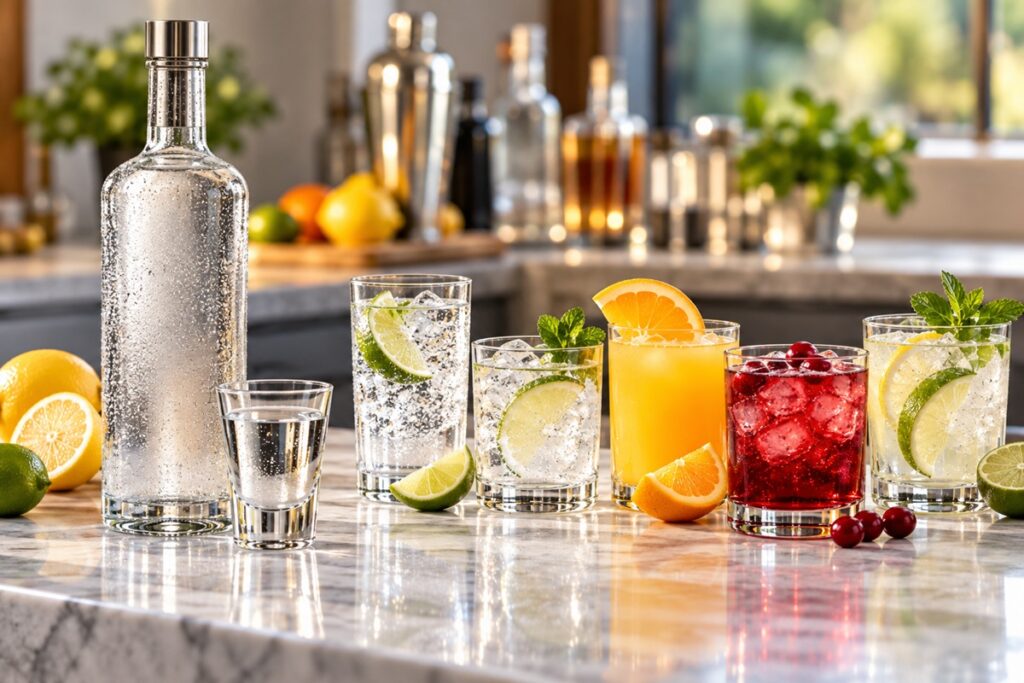
A higher proof means more alcohol in the same pour and more calories with it. In the United States, proof is double the alcohol percentage by volume.
Alcohol carries about 7 calories per gram (6.93 in USDA’s calculations). A 1.5 oz shot of 80-proof contains about 14 g of alcohol, which provides about 97 calories. Every extra gram from a higher proof can increase the calorie count.
| Proof | Alcohol by volume | Alcohol per 1.5 fluid ounce | Calories per 1 fluid ounce | Calories per 1.5 fluid ounce | kJ per 1.5 fluid ounce |
|---|---|---|---|---|---|
| 80 | 40% | 14.0 g | 64 | 97 | 406 |
| 86 | 43% | 15.1 g | 70 | 105 | 439 |
| 90 | 45% | 15.9 g | 73 | 110 | 460 |
| 94 | 47% | 16.7 g | 76 | 116 | 485 |
| 100 | 50% | 17.9 g | 82 | 124 | 519 |
| Mixer | With 4 fluid ounces | With 6 fluid ounces | Sugar in 6 fluid ounces of mixer |
|---|---|---|---|
| Club soda (soda water) | 97 | 97 | 0 g |
| Tonic water | 138 | 159 | 16.1 g |
| Orange juice | 155 | 184 | 15.2 g |
| Cranberry juice cocktail | 165 | 199 | 22.6 g |
| 100% cranberry juice | 155 | 184 | 23 g |
Each figure includes one 1.5-ounce shot of 80-proof vodka mixed with the stated mixer. A mixer’s calories come from its sugar content. Club soda has no sugar, so it adds no calories. Tonic water is sugar-sweetened, so it does add calories.
Drinking on a GLP-1 Medication: What the Labels Say About Alcohol
The labels for Wegovy (semaglutide), Ozempic (semaglutide), and Zepbound (tirzepatide) have no alcohol warnings and no post-dose waiting rules for drinking alcohol. They do warn about stomach upset, low blood sugar, dehydration, and pancreatitis, and alcohol can cause some of the same problems. Ask your prescriber what is safe for you.
Can You Drink Alcohol on Tirzepatide (Zepbound or Mounjaro)?
Lilly, the maker, doesn’t make a recommendation on whether you can drink alcohol on tirzepatide because it hasn’t studied the combination. It gives that answer for Zepbound and alcohol, and again for Mounjaro and alcohol. Its trials of both drugs left out people with a history of alcohol abuse.
Tirzepatide has its own rates for the stomach upset the labels warn about. Across the three doses in the Zepbound label’s two 72-week weight trials, 25% to 29% had nausea, against 8% on placebo. Diarrhea affected 19% to 23%, against 8%, and vomiting 8% to 13%, against 2%. Most of these cases came during dose escalation, while the dose goes up in steps. They became less common over time.
Low blood sugar on tirzepatide is reported mainly in people with type 2 diabetes. The Zepbound label puts it at 4.2% in a type 2 diabetes trial, against 1.3% on placebo. With a sulfonylurea, a kind of diabetes pill, the rate was 10.3%. Without one, it was 2.1%. The Mounjaro label reports 9.9% to 13.8% in one trial where people also took a sulfonylurea.
Everyone in the Zepbound weight trials was told to aim for a daily deficit of about 500 calories. If you have two vodka cranberries from the mixer table, that’s 398 calories, or about four-fifths of the deficit.
No randomized trial testing tirzepatide on drinking has been completed. A 2026 health-records study followed US adults with type 2 diabetes for 18 months. It compared people starting tirzepatide with people starting an older diabetes drug. Among the 7,165 on tirzepatide, new diagnoses of problem drinking, or alcohol use disorder, were about half as common.
Because the study is observational, it can’t show that tirzepatide caused the difference. Lilly says tirzepatide isn’t indicated for treating alcohol use disorder.
Alcohol Calories on a Smaller Appetite
The Wegovy label says semaglutide decreases calorie intake, likely through its effects on decreased appetite. That change doesn’t remove calories from a drink. Two vodka tonics made with 6 oz of tonic each still add up to 318 calories.
A 2019 review of 22 studies found that people didn’t eat less to make up for alcohol calories. Food intake increased by about 82 calories after drinking. Most participants were young adults.
On calories alone, vodka with club soda has 97. The same shot with 6 oz of cranberry juice cocktail has 199 calories.
Side Effects Alcohol Can Add
In Wegovy weight-loss trials, 44% of people taking the drug had nausea, compared with 16% on placebo. For vomiting, the figures were 24% and 6%. A 2025 fact sheet says alcohol irritates the stomach lining and increases urination, so the body loses fluid.
The Wegovy label says semaglutide delays gastric emptying, so food stays in the stomach longer. Most reported kidney-injury cases followed dehydration from nausea, vomiting, or diarrhea, and the drug label recommends avoiding fluid loss. The label also warns that Wegovy can cause low blood sugar, with a higher risk when it’s used with insulin or a sulfonylurea medication.
Diabetes guidance from 2021 says alcohol makes blood sugar harder to keep steady, especially without food, and can mask early symptoms of low blood sugar (hypoglycemia). It says eating some food while you drink is safer. That guidance is for people with diabetes.
The 2025–2030 dietary guidelines list people taking medications that can interact with alcohol among those who should avoid it completely. The guidelines name no specific drug.
Labels for Wegovy and Zepbound warn about acute pancreatitis. A pancreatitis fact sheet from 2017 lists heavy alcohol use among the most common general causes. The two facts are separate, and the labels name no combined risk.
For tablets, the Wegovy and Rybelsus labels mention taking the dose with water only. They suggest waiting at least 30 minutes before consuming any food or drink, alcohol included. That’s the labels’ only timing rule, and it isn’t specific to alcohol.
Reports of Less Craving
Two recent trials tested semaglutide in adults with alcohol use disorder. A 2025 trial ran for nine weeks with 48 adults who were not seeking treatment. It found less craving and fewer drinks on drinking days, with no change in the number of drinking days.
A 2026 trial followed 108 adults with alcohol use disorder plus obesity for 26 weeks. Heavy-drinking days fell by 41.1 percentage points with semaglutide and by 26.4 points with placebo. Results are mixed across trials, and no GLP-1 drug is approved to treat alcohol use disorder. These findings don’t show that everyone on a GLP-1 drinks less.
For the nausea timeline and warning signs, see GLP-1 side effects and what to eat.
Does Vodka Have Carbs or Sugar?
Plain vodka has 0 g of carbohydrate in a 1.5 oz serving. Vodka can hold up to 2 g of sugar per liter under US rules. At that limit, a 1.5 oz shot holds under 0.1 g.
US rules let vodka be distilled from any suitable material. It must reach at least 95% alcohol during distillation and be bottled at 40% or higher. Federal data list only trace minerals and B vitamins.
The 97 calories in the shot come with almost no nutrients. Those are empty calories.
Vodka vs. Other Spirits, Wine, and Beer
Each row uses a common US serving size, so the volumes differ.
| Drink | Serving in fluid ounces | Calories | Alcohol | Carbs |
|---|---|---|---|---|
| Vodka, 80-proof | 1.5 oz | 97 | 14.0 g | 0 g |
| Table wine | 5 oz | 123 | 15.4 g | 4.0 g |
| Regular beer | 12 oz | 153 | 13.9 g | 12.6 g |
| Light beer | 12 oz | 103 | 11.0 g | 5.8 g |
| Hard seltzer | 12 oz | 86 | 11.5 g | 2.0 g |
Federal data put gin, rum, whiskey, and vodka at 80-proof under one shared data point. So each unflavored spirit in that data point has the same 97 calories per 1.5 oz.
Each of the five drinks has between 11.0 g and 15.4 g of alcohol per serving. Beer and wine add carbs on top of that alcohol, which explains their extra calories.
Vodka isn’t the lowest-calorie alcohol in the table. A 12 oz hard seltzer has 86 calories, fewer than a 97-calorie shot. A light beer has 103, only six more than the shot.
Vodka also isn’t more fattening than other alcohols. A plain shot of vodka has fewer calories than a 5 oz glass of wine, 97 compared with 123. However, if you add a sugary mixer, the vodka drink can have more calories than the wine.
How Many Calories in a Shot of Vodka: Singles, Doubles, and Bottles
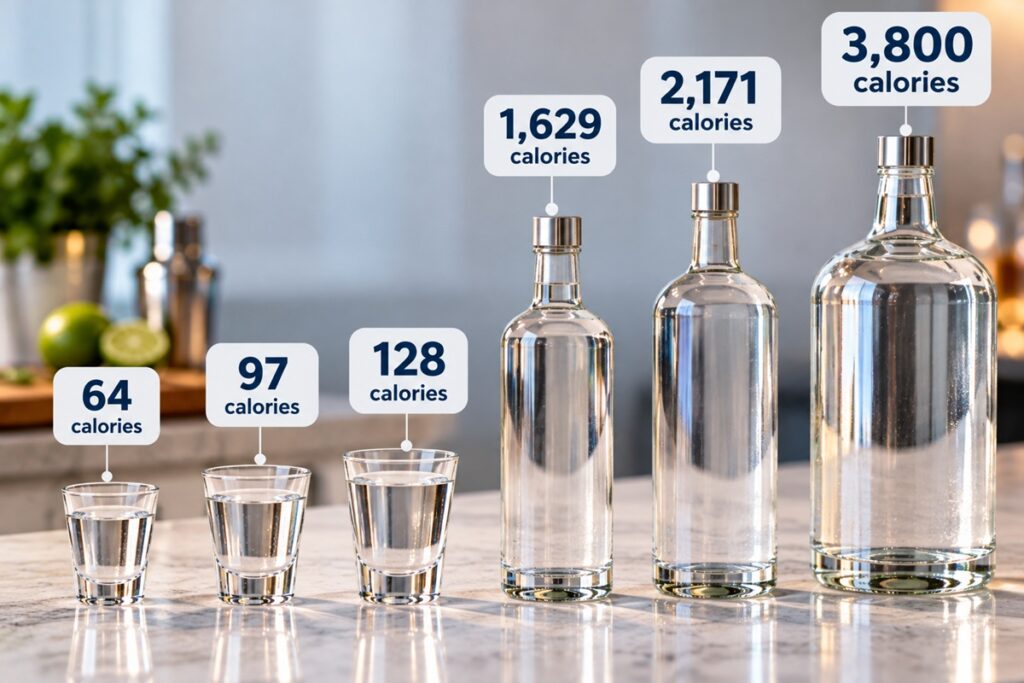
A standard US shot of 80-proof vodka, 1.5 oz, has 97 calories. No single shot size explains every figure sources give. You have to match the number to the pour. A 1 oz pour of 80-proof vodka has 64 calories, which matches the 1 oz federal portion.
A 1.5 oz pour is the US standard drink for spirits and has 97 calories with about 14 g of pure alcohol. A 2 oz pour, the base used in federal cocktail recipes, has 128 calories.
A UK single shot of 25 mL (0.85 oz) has 54 calories, and a UK double of 50 mL (1.7 oz) has 109 calories.
A bottle holds many shots, so its calorie total is large. A 750 mL (25.4 oz) bottle of 80-proof vodka has 1,629 calories, about 17 shots. A 1-liter (33.8 oz) bottle has 2,171 calories. A 1.75-liter (59.2 oz) bottle has about 3,800 calories. Per 100 mL (3.4 oz) the figure is 217 calories.
Some sources list 231 calories per 100 mL. That 231 is the per-100-gram figure. Vodka is lighter than water, so 100 mL weighs less than 100 g and holds 217 calories.
Calories in Popular Vodka Cocktails
Federal recipe data measure most of these drinks from 2 fluid ounces of 80-proof vodka and about 5.5 fluid ounces of mixer. These drinks therefore run higher than a 1.5 oz shot with 4 or 6 oz of mixer.
| Drink | What’s in it | Calories |
|---|---|---|
| Vodka soda | vodka, club soda | 133 |
| Vodka and diet cola | vodka, diet cola | 135 |
| Bloody Mary | vodka, tomato juice, Worcestershire, horseradish, chili | 164 |
| Vodka tonic | vodka, tonic | 189 |
| Vodka and cola | vodka, cola | 200 |
| Moscow mule | vodka, ginger ale, sugar | 205 |
| Screwdriver | vodka, orange juice | 207 |
| Cape Cod (vodka cranberry) | vodka, cranberry juice cocktail | 220 |
| Martini | 3.5 oz of 80-proof spirit, 0.5 oz non-alcoholic wine | 241 |
USDA has no separate cosmopolitan entry.
Does Flavored Vodka Have More Calories?
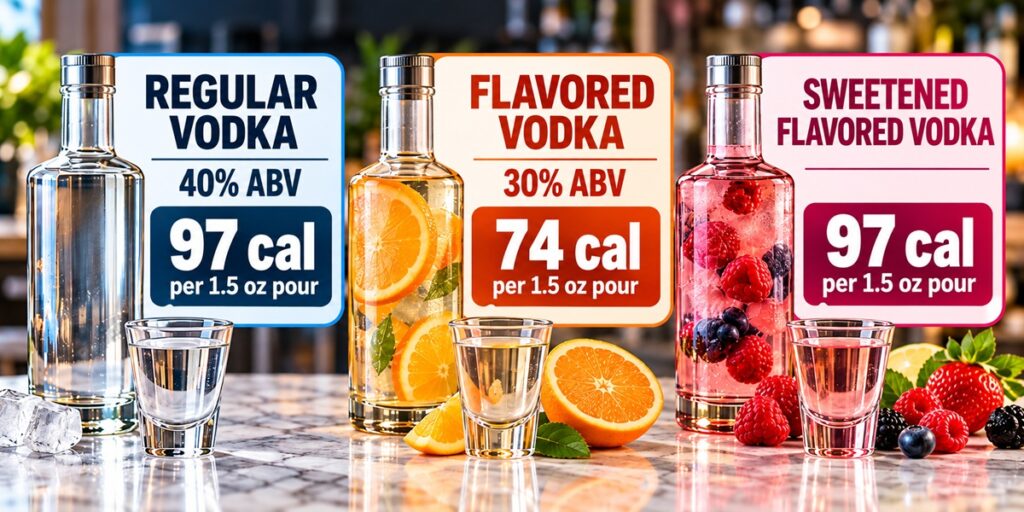
Flavored vodka can have more or fewer calories than regular vodka. Alcohol strength matters first and added sugar second. US rules let flavored vodka be bottled as low as 30% alcohol, and it can carry added sugar. A 1.5 oz pour at 30% comes to about 74 calories by calculation, fewer than the same pour of regular 40% vodka.
One brand sells both strengths. Grey Goose lists 40% for its flavored vodkas and 30% for its natural-flavor line. Both show zero carbs in a 1.5 oz serving. Grey Goose lists 73 calories per 1.5 oz for its 30% line.
Sweetened flavors can add sugar on top of the alcohol calories. Calorie labeling on spirits is optional, so the label may give no figure at all. Check the alcohol percentage on the label before you compare two flavors.
Why Most Vodka Bottles Don’t List Calories
US spirit labels must show alcohol by volume. Calories aren’t required on that label. Federal rules have let producers add a voluntary Serving Facts panel since 2013. It lists calories, carbs, protein, and fat per serving.
Manufacturers such as Grey Goose use that voluntary panel and list 98 calories per 1.5 oz. Its 98 calories differ from the federal database figure of 97 only by rounding.
A 2025 proposal made including an Alcohol Facts statement with calories and nutrients as a requirement. As of September 2026, it remains only a proposal.
Is Vodka Fattening?
Vodka’s calories count toward your day like any others, but very little of its alcohol is turned into fat. Sources split between yes and no, and each is partly right.
In a small 1999 study, eight men received about 24 g of alcohol. Under 5% of that alcohol was turned into fat. Their whole-body fat burning, however, fell 73% while their bodies cleared the alcohol.
Drinking also changes what you eat next. The 2019 review described above found higher food intake after drinking.
For calorie counts on common fast-food orders, see what a late food order adds.
The current federal dietary guidelines no longer set a daily drink number and instead advise drinking less for better health.
How to Cut the Calories in a Vodka Drink
You can cut the calories in a vodka drink with any of these four changes:
- Order vodka with club soda rather than 6 oz of cranberry juice cocktail. That swap cuts 102 calories.
- Pour 1.5 oz with a jigger instead of a 2 oz free pour. At 80-proof, the smaller measure holds 31 fewer calories.
- Pick a lower-proof flavored vodka. A 30% flavored vodka has about 74 calories a shot, compared with 97 for 80-proof. A sweetened flavor can add sugar calories to that figure.
- Have one fewer drink. Each 1.5 oz shot of 80-proof you skip saves 97 calories.
Note: This article is for educational purposes and is not medical advice. Check with your prescriber about alcohol use.
More Calorie Counts
- Calories in Chicken Breast
- Protein in Chicken Breast
- Banana Calories
- Calories in an Egg
- Apple Calories
- Big Mac Calories
- Calories in Strawberries
- Calories in Grapes
- Rice Calories
- Calories in a Slice of Pizza
- Baked Potato Calories
- Calories in Food: the full guide
Sources
- FoodData Central: vodka, distilled spirits by proof, mixers, wine, beer, and mixed drinks, USDA, 2019 and 2024
- What Is a Standard Drink? and Hangovers, NIAAA, 2025
- Ruling 2013-2: Voluntary Nutrient Content Statements, TTB, 2013; Alcohol Facts Statements proposed rule, 2025
- Neutral spirits (vodka), 27 CFR 5.142 and Flavored spirits, 27 CFR 5.151, eCFR, 2022
- Food energy: methods of analysis and conversion factors, FAO, 2003
- Prescribing information: Wegovy, Ozempic, Rybelsus, and Zepbound, 2026
- Low blood glucose (2021) and causes of pancreatitis (2017), NIDDK
- Alcohol and food energy intake: systematic review, Kwok et al., 2019; Alcohol and fat metabolism, Siler et al., 1999
- Semaglutide in adults with alcohol use disorder, Hendershot et al., 2025; Semaglutide in alcohol use disorder and obesity, Klausen et al., 2026
- Dietary Guidelines for Americans, 2025–2030, USDA and HHS, 2026