
With butter, sour cream, cheddar, and bacon on top, a 161-calorie baked potato becomes a 532-calorie one. The plain count is for a medium potato with skin, weighing 173 grams (6.1 oz). The loaded count adds one tbsp butter, two tbsp sour cream, 1/4 cup shredded cheddar, and two slices of bacon.
On its own, a medium potato has about 37 grams of carbohydrates, four grams of protein, and under one gram of fat.
Calories in a Baked Potato by Size
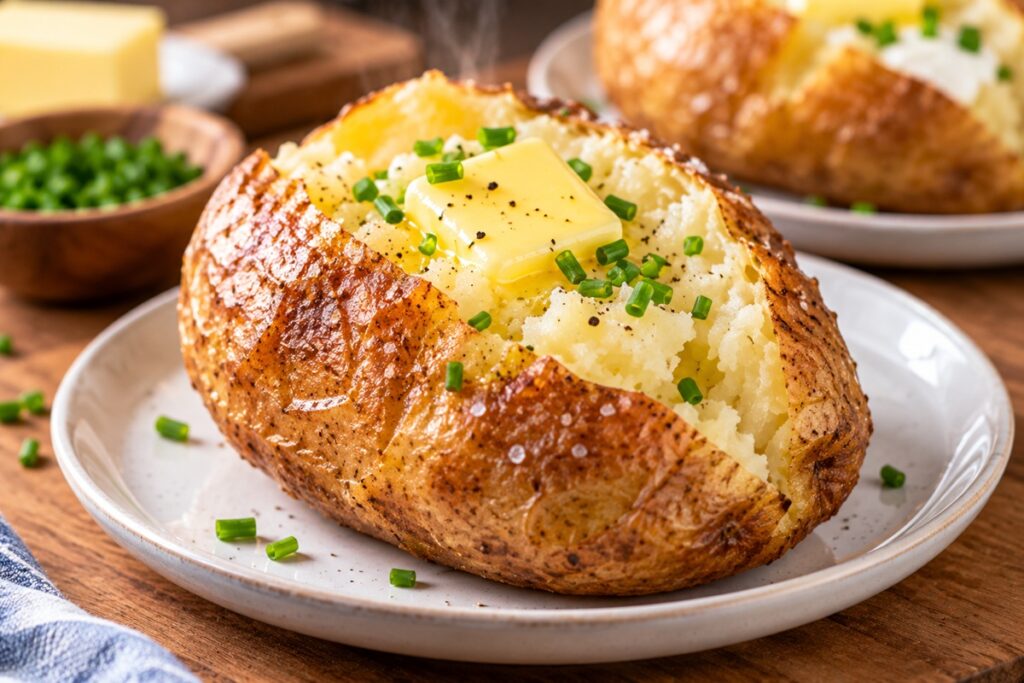
Baked potato calories depend on weight because the USDA lists the same 93 calories per 100 grams for every size. The USDA’s entry for a baked potato with skin and no salt provides the following calorie counts by size and weight:
| Potato size | Weight | With skin | Without skin, estimate |
|---|---|---|---|
| Small | 138 g (4.9 oz) | 128 | about 100–115 |
| Medium | 173 g (6.1 oz) | 161 | about 125–145 |
| Large | 299 g (10.5 oz) | 278 | about 215–250 |
| Per 100 g | 100 g (3.5 oz) | 93 | same |
| Per 1 oz | 28.35 g | 26 | same |
USDA labels diameters as small about 1 3⁄4–2 1⁄2 inches, medium about 2 1⁄4–3 1⁄4 inches, and large about 3–4 1⁄4 inches, and those ranges overlap.
If your potato’s diameter fits two labels, use its weight instead. Russet, white, and red potatoes of the same weight differ by 25 calories or less. You can compare these counts with calorie counts for other everyday foods.
How Big Is a Medium Baked Potato?
A medium baked potato weighs 173 grams (6.1 oz) in USDA’s standard reference, where it has 161 calories with skin. The USDA’s survey database, built from what people report eating, puts a medium at 285 grams (10.1 oz) and 265 calories.
Sources list 161, 164, or 265 calories for a medium potato because they use different weights and potato types. A steakhouse or hot-bar potato is more likely to weigh close to 285 grams, while a kitchen scale can give you the exact weight.
Raw versus baked potato calories differ per 100 grams because baking removes water. A raw potato with skin has 77 calories per 100 grams and baked has 93, yet a whole potato has about the same total either way. For 200 calories, you need about 215 grams (7.6 oz) of plain baked potato with skin, or about one and one-quarter medium potatoes.
With the Skin or Without It
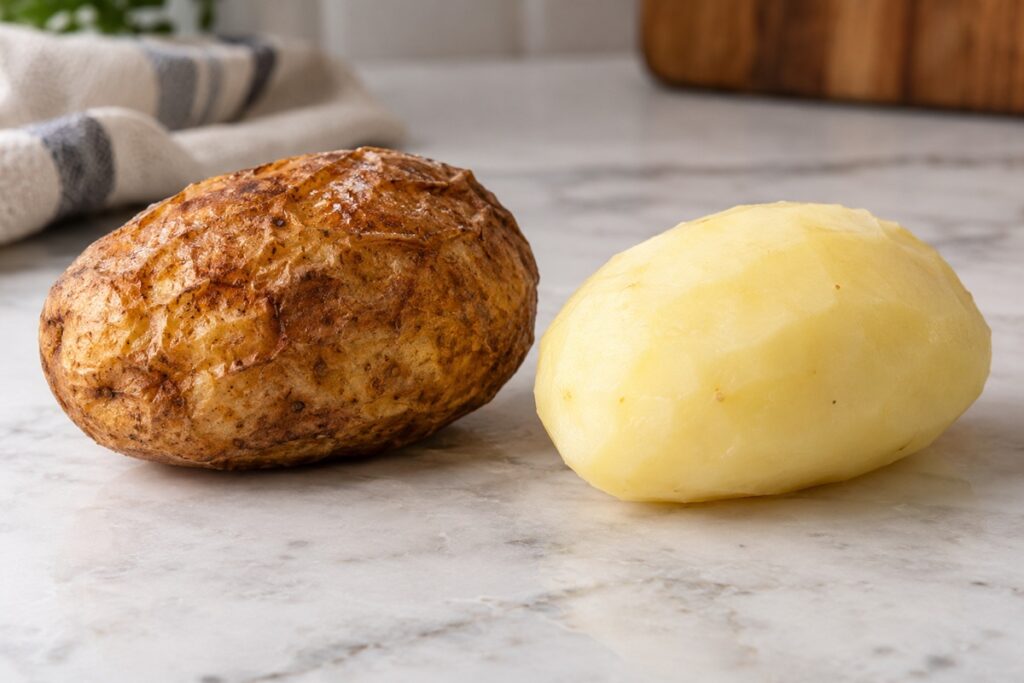
Peeling a medium potato saves an estimated 15–35 calories, but keep in mind that this removes some of the nutrients. Per 100 grams, baked flesh and baked flesh with skin both have 93 calories, but USDA’s separate entry for baked skin alone is 198 calories per 100 grams because the skin is drier, so the saving depends on how thick a layer you peel off.
Skin has 7.9 grams of fiber per 100 grams and flesh has 1.5 grams, and a medium with skin has 3.8 grams of fiber. Skip the skin and you’ll lose much of that fiber for a small calorie saving.
Baked Potato Calories With Toppings
Calories in a baked potato go up with every topping. The USDA lists these calorie counts for common toppings, each measured in one household serving:
| Topping | Amount | Calories |
|---|---|---|
| Butter | 1 tbsp | 102 |
| Butter | 1 pat | 36 |
| Sour cream | 2 tbsp | 48 |
| Shredded cheddar | ¼ cup | 114 |
| Bacon, pan-fried | 1 slice | 54 |
| Nonfat plain Greek yogurt | 2 tbsp | 18 |
| 1%-fat cottage cheese | ½ cup | 81 |
| Salsa | 2 tbsp | 10 |
| Chives | 1 tbsp | 1 |
| Broccoli, cooked | ½ cup | 27 |
| Chili with beans | ½ cup | 130 |
| Baked beans, vegetarian | ½ cup | 119 |
| Olive oil | 1 tbsp | 119 |
| Ranch dressing | 2 tbsp | 129 |
Of the four classic toppings, cheddar and butter add the most. For a steak, potato, and salad dinner, compare the total with other typical meals and their calorie counts.
The Fully Loaded Potato
The four classic toppings add 371 calories, more than twice the 161 in a plain medium. With all four, a small potato comes to 499 (3.9 times plain), a medium to 532 (3.3 times), and a large to 649 (2.3 times).
A pat of butter with two tbsp sour cream on a medium potato totals 245 calories, so one or two toppings don’t triple the count. The four toppings also add about 34 grams of fat, 18 grams of it saturated, which is close to the full-day Daily Value of 20 grams. USDA’s survey database counts its own loaded potato, a 285-gram (10.1 oz) potato with butter, sour cream, cheddar, and bacon, at 588.
Lighter Toppings
A medium potato with two tbsp of Greek yogurt, 2 tbsp of salsa, 1 tbsp of chives, and ½ cup of cooked broccoli totals 218. Topped instead with ½ cup 1%-fat cottage cheese, two tbsp of salsa, and one tbsp of scallions, it totals 255, with about 19 grams of protein. With ½ cup of chili with beans, a medium potato totals 291 calories.
Per two tbsp, Greek yogurt has about five times the protein of sour cream, 3.1 grams compared with 0.6 g, and 18 calories against 48.
Greek yogurt and cottage cheese are among the protein foods a 2025 joint advisory encourages for people taking GLP-1 (glucagon-like peptide-1) medicines such as Ozempic. If you’re on one, either Greek yogurt or cottage cheese will add protein to a potato for fewer calories than ¼ cup cheddar or two slices of bacon.
Baked, Microwaved, or Rubbed With Oil
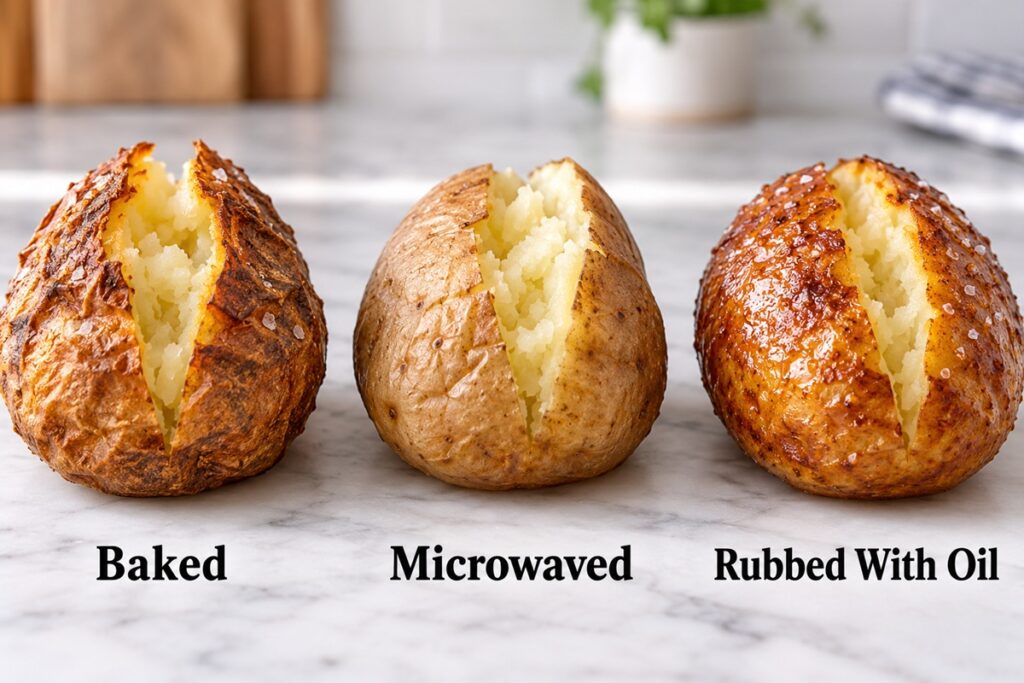
Baking and microwaving don’t add calories on their own. A whole potato has about the same total calories whichever way you cook it. An olive oil rub can add up to 119 calories per tablespoon, although how much stays on the skin is unknown.
FDA studies show that the cooking method can change how much acrylamide forms. Acrylamide is a chemical that can form when starchy foods, such as potatoes, are cooked at high temperatures. Since high exposure to this chemical may come with health risks, it’s generally recommended to limit it when possible. Microwaving a whole potato in its skin forms none, and neither does boiling. Baking whole potatoes forms less acrylamide than roasting pieces, while frying forms the most.
FDA also advises storing raw potatoes outside the refrigerator because cold storage can increase acrylamide during cooking. However, the FDA doesn’t advise that you stop eating baked, roasted, or fried foods.
How Many Calories in a Baked Potato Fit Your Day?
A plain medium baked potato takes up about 8% of a 2,000-calorie day, and a loaded medium takes up about 27%.
In a 1995 study of 38 foods with equal calorie counts, boiled potatoes were rated the most filling, at about three times white bread. The study used boiled potatoes, not baked ones. It also found that higher-fat foods tended to be less filling per calorie, and that most of the loaded toppings’ calories come from fat.
Blood Sugar and Cooled Potatoes
Baked russet potatoes had a glycemic index (GI) of 77 in a 2005 study of North American potatoes. That’s well over the low-GI range of 55 or under.
Boiled red potatoes eaten cold scored 56 in that study, and precooked, chilled, then reheated russets gave a lower blood sugar response than freshly cooked ones. Cooked, then chilled potatoes have more resistant starch, but cooling hasn’t been shown to cut calories.
Carbs, Protein, and Potassium in a Medium Baked Potato
A medium potato with skin weighs 173 grams (6.1 oz) and has 36.7 grams of carbohydrate, 3.8 grams of fiber, 4.3 grams of protein, and 0.2 grams of fat. It also has 926 milligrams of potassium, 20% of the Daily Value. That’s more than twice the 422 milligrams in a medium banana.
For those planning meals around exercise, a potato gives you carbohydrates and potassium with almost no fat. In one small cycling study, funded by a potato industry group, potato puree matched a carbohydrate gel in terms of blood glucose and finishing time during a long ride. However, the cyclists did report more stomach discomfort with the potato.
That study measured endurance, not muscle gain. The same medium also gives you 0.54 milligrams of vitamin B6, 32% of the Daily Value, and 16.6 milligrams of vitamin C, 18% of the Daily Value.
More Calorie Counts
- Calories in Chicken Breast
- Protein in Chicken Breast
- Banana Calories
- Calories in an Egg
- Apple Calories
- Big Mac Calories
- Calories in Strawberries
- Calories in Grapes
- Rice Calories
- Calories in Vodka
- Calories in a Slice of Pizza
- Calories in Food: the full guide
Sources
- FoodData Central: potatoes, baked, flesh and skin, without salt (170093); baked russet (170030), white (170434), and red (170435); baked flesh (170033) and skin (170034); raw (170026), USDA, 2019
- FoodData Central: potato, baked, peel eaten (FNDDS 2709524) and with sour cream, cheese, and meat (FNDDS 2709528), USDA, 2024
- FoodData Central toppings: butter (173410), sour cream (171257), cheddar (173414), bacon (168322), salsa (174524), chives (169994), scallions (170005), broccoli (169967), 1% cottage cheese (173417), chili with beans (172097), baked beans (175182), olive oil (171413), and ranch dressing (173592), USDA, 2019; nonfat plain Greek yogurt (FNDDS 2705424), USDA, 2024
- Acrylamide and Diet, Food Storage, and Food Preparation, FDA, 2024
- Acrylamide Questions and Answers, FDA, 2024
- Daily Value on the Nutrition and Supplement Facts Labels, FDA, 2024
- Potassium: Fact Sheet for Health Professionals, NIH Office of Dietary Supplements, 2022
- A satiety index of common foods, 1995
- Glycemic index of potatoes commonly consumed in North America, 2005
- International tables of glycemic index and glycemic load values, 2021
- Resistant starch content in foods commonly consumed in the United States, 2020
- Potato ingestion is as effective as carbohydrate gels to support prolonged cycling performance, 2019
- Nutritional priorities to support GLP-1 therapy for obesity, a joint advisory, 2025